
Maintainer: Michael Hahsler
This R package extends arules with NBMiner, an implementation of the model-based mining algorithm for NB-frequent itemsets described in Michael Hahsler’s paper, “A model-based frequency constraint for mining associations from transaction data.” Data Mining and Knowledge Discovery, 13(2):137-166, September 2006.
This algorithm dynamically chooses support for itemsets based on the deviation from a fitted independence model. NBMiner is better at suppressing spurious patters and finds interesting patterns with lower support compared to the traditional minimum support-based algorithms.
Installation
Stable CRAN version: Install from within R with
install.packages("arulesNBMiner")Current development version: Install from r-universe.
install.packages("arulesNBMiner",
    repos = c("https://mhahsler.r-universe.dev",
              "https://cloud.r-project.org/"))
Usage
Estimate negative binomial distribution (NBD) model parameters for the arules Groceries data set.
library("arulesNBMiner")
data("Groceries")

param <- NBMinerParameters(Groceries, trim = 0.1)
## 17 item(s) trimmed, leaving 152 items.
## using Expectation Maximization for missing zero class
## iteration = 1 , zero class = 2 , k = 0.86 , m = 153
## total items = 154
##
## Goodness of fit/chi-square test on binned count data
## H0: Observed counts match the expected proportions.
## Bins: 10
## X-squared = 6.6 with 9 degrees of freedom
## p.value = 0.68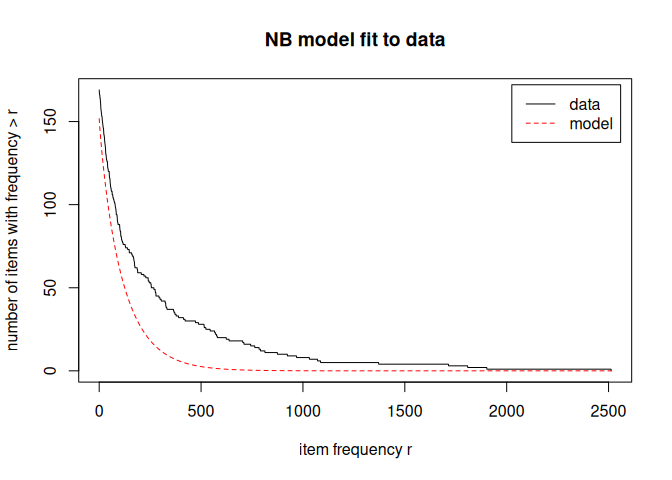 Note that the model shows independence but the dataset contains a significant amount of correlated items shown by the larger cumulative frequency.
Mine NB-frequent itemsets
itemsets_NB <- NBMiner(Groceries, parameter = param, minlen = 2L)
itemsets_NBAdd support and inspect some NB-frequent itemsets with the highest precision.
quality(itemsets_NB) <- cbind(quality(itemsets_NB), support = interestMeasure(itemsets_NB,
    "support", transactions = Groceries))

inspect(head(itemsets_NB, by = "precision"))
## items precision support
## [1] {bottled beer, liquor, red/blush wine} 1 0.00193
## [2] {bottled beer, liquor} 1 0.00468
## [3] {soda, bottled beer, liquor, red/blush wine} 1 0.00081
## [4] {whole milk, curd} 1 0.02613
## [5] {whole milk, rolls/buns, margarine} 1 0.00793
## [6] {whole milk, butter} 1 0.02755A precision close to 1 means that there is very little chance that they are spurious. We see that some very low support itemsets are under the top NB-frequent itemsets.
References
- Michael Hahsler, A model-based frequency constraint for mining associations from transaction data. Data Mining and Knowledge Discovery, 13(2):137-166, September 2006. Preprint on ArXiv
- Michael Hahsler, Sudheer Chelluboina, Kurt Hornik, and Christian Buchta. The arules R-package ecosystem: Analyzing interesting patterns from large transaction datasets. Journal of Machine Learning Research, 12:1977-1981, 2011.