Provides the generic function match() and the methods for
associations, transactions and itemMatrix objects. match() returns a vector
of the positions of (first) matches of its first argument in its second.
Usage
match(x, table, nomatch = NA_integer_, incomparables = NULL)

# S4 method for class 'itemMatrix,itemMatrix'
match(x, table, nomatch = NA_integer_, incomparables = NULL)

# S4 method for class 'rules,rules'
match(x, table, nomatch = NA_integer_, incomparables = NULL)

# S4 method for class 'itemsets,itemsets'
match(x, table, nomatch = NA_integer_, incomparables = NULL)

# S4 method for class 'itemMatrix,itemMatrix'
x %in% table

# S4 method for class 'itemMatrix,character'
x %in% table

# S4 method for class 'associations,associations'
x %in% table

# S4 method for class 'itemMatrix,character'
x %pin% table

# S4 method for class 'itemMatrix,character'
x %ain% table

# S4 method for class 'itemMatrix,character'
x %oin% table
Arguments
- x
an object of class itemMatrix, transactions or associations.
- table
a set of associations or transactions to be matched against.
- nomatch
the value to be returned in the case when no match is found.
- incomparables
a logical; If
TRUEthen match recodes incompatible item orders quietly. Otherwise, recoding will create a warning.
Value
match: An integer vector of the same length as x
giving the position in table of the first match if there is a match,
otherwise nomatch.
%in%, %pin%, %ain%, %oin%: A logical vector,
indicating if a match was located for each element of x.
Details
%in% is a more intuitive interface as a binary operator, which
returns a logical vector indicating if there is a match or not for the items
in the itemsets (left operand) with the items in the table (right operand).
arules defines additional binary operators for matching itemsets:
%pin% uses partial matching on the table; %ain%
itemsets have to match/include all items in the table; %oin%
itemsets can only match/include the items in the table. The binary
matching operators or often used in subset().
See also
Other associations functions:
abbreviate(),
associations-class,
c,
duplicated(),
extract,
inspect(),
is.closed(),
is.generator(),
is.maximal(),
is.redundant(),
is.significant(),
is.superset(),
itemsets-class,
rules-class,
sample(),
sets,
size(),
sort(),
unique()
Other itemMatrix and transactions functions:
abbreviate(),
c,
crossTable(),
duplicated(),
extract,
hierarchy,
image,
inspect(),
is.superset(),
itemFrequency(),
itemFrequencyPlot(),
itemMatrix-class,
itemwiseSetOps,
merge(),
random.transactions(),
sample(),
sets,
size(),
supportingTransactions(),
tidLists-class,
transactions-class,
unique()
Examples
data("Adult")
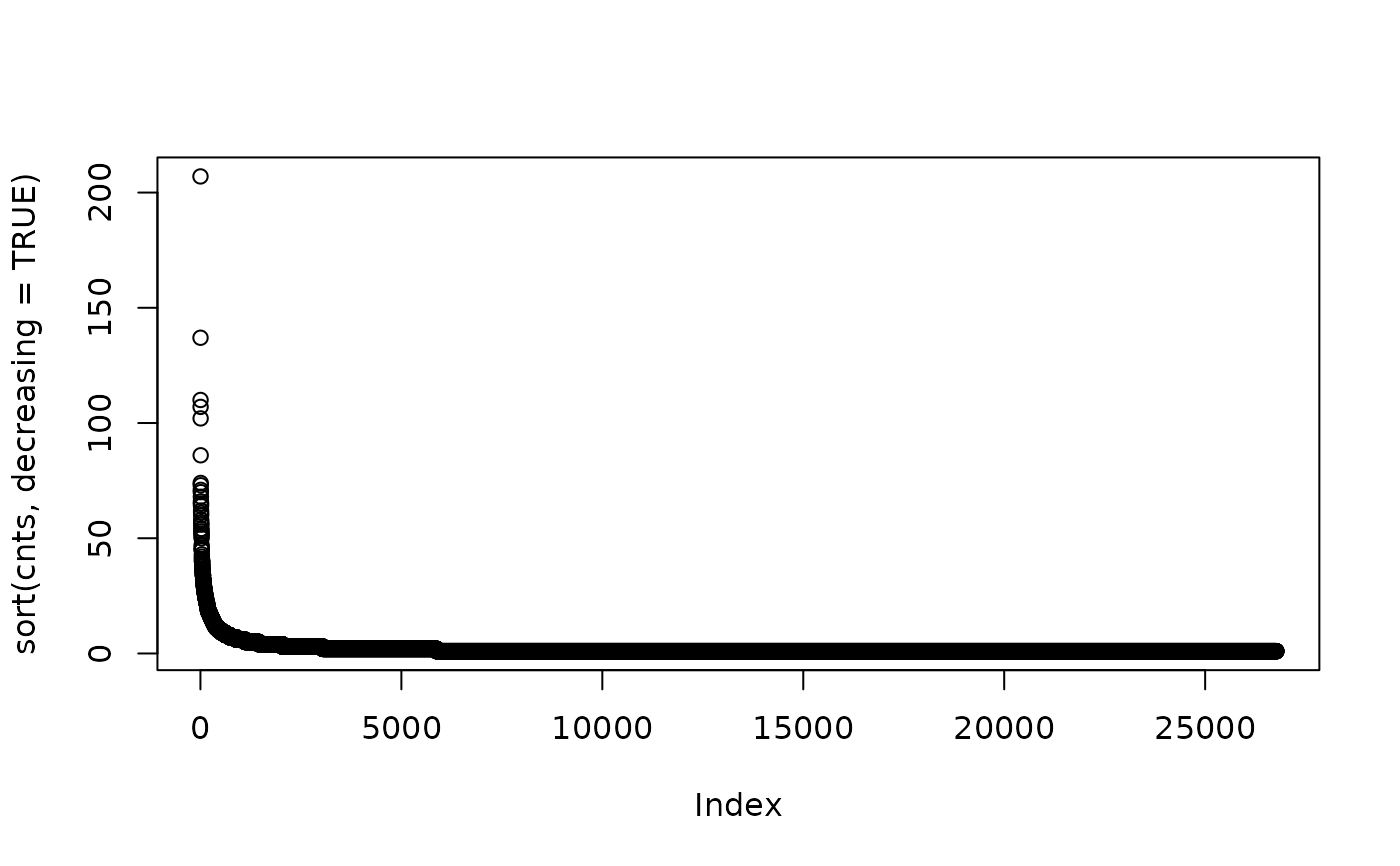
## get unique transactions, count frequency of unique transactions
## and plot frequency of unique transactions
vals <- unique(Adult)
cnts <- tabulate(match(Adult, vals))
plot(sort(cnts, decreasing = TRUE))
 ## find all transactions which are equal to transaction 10 in Adult
which(Adult %in% Adult[10])
#> [1] 10 8438 8595 12023 12752 24123 24455 28063
## for transactions we can also match directly with itemLabels.
## Find in the first 10 transactions the ones which
## contain age=Middle-aged (see help page for class itemMatrix)
Adult[1:10] %in% "age=Middle-aged"
#> [1] TRUE FALSE TRUE FALSE TRUE TRUE FALSE FALSE TRUE TRUE
## find all transactions which contain items that partially match "age=" (all here).
Adult[1:10] %pin% "age="
#> [1] TRUE TRUE TRUE TRUE TRUE TRUE TRUE TRUE TRUE TRUE
## find all transactions that only include the item "age=Middle-aged" (none here).
Adult[1:10] %oin% "age=Middle-aged"
#> [1] FALSE FALSE FALSE FALSE FALSE FALSE FALSE FALSE FALSE FALSE
## find al transaction which contain both items "age=Middle-aged" and "sex=Male"
Adult[1:10] %ain% c("age=Middle-aged", "sex=Male")
#> [1] TRUE FALSE TRUE FALSE FALSE FALSE FALSE FALSE FALSE TRUE
## find all transactions which are equal to transaction 10 in Adult
which(Adult %in% Adult[10])
#> [1] 10 8438 8595 12023 12752 24123 24455 28063
## for transactions we can also match directly with itemLabels.
## Find in the first 10 transactions the ones which
## contain age=Middle-aged (see help page for class itemMatrix)
Adult[1:10] %in% "age=Middle-aged"
#> [1] TRUE FALSE TRUE FALSE TRUE TRUE FALSE FALSE TRUE TRUE
## find all transactions which contain items that partially match "age=" (all here).
Adult[1:10] %pin% "age="
#> [1] TRUE TRUE TRUE TRUE TRUE TRUE TRUE TRUE TRUE TRUE
## find all transactions that only include the item "age=Middle-aged" (none here).
Adult[1:10] %oin% "age=Middle-aged"
#> [1] FALSE FALSE FALSE FALSE FALSE FALSE FALSE FALSE FALSE FALSE
## find al transaction which contain both items "age=Middle-aged" and "sex=Male"
Adult[1:10] %ain% c("age=Middle-aged", "sex=Male")
#> [1] TRUE FALSE TRUE FALSE FALSE FALSE FALSE FALSE FALSE TRUE