Class to represent transaction ID lists and associated methods.
Usage
tidLists(x)

# S4 method for class 'tidLists'
summary(object, maxsum = 6, ...)

# S4 method for class 'tidLists'
dim(x)

# S4 method for class 'tidLists'
dimnames(x)

# S4 method for class 'tidLists,list'
dimnames(x) <- value

# S4 method for class 'tidLists'
length(x)

# S4 method for class 'tidLists'
t(x)

# S4 method for class 'tidLists'
transactionInfo(x)

# S4 method for class 'tidLists'
transactionInfo(x) <- value

# S4 method for class 'tidLists'
itemInfo(object)

# S4 method for class 'tidLists'
itemInfo(object) <- value

# S4 method for class 'tidLists'
itemLabels(object)

# S4 method for class 'tidLists'
labels(object)Details
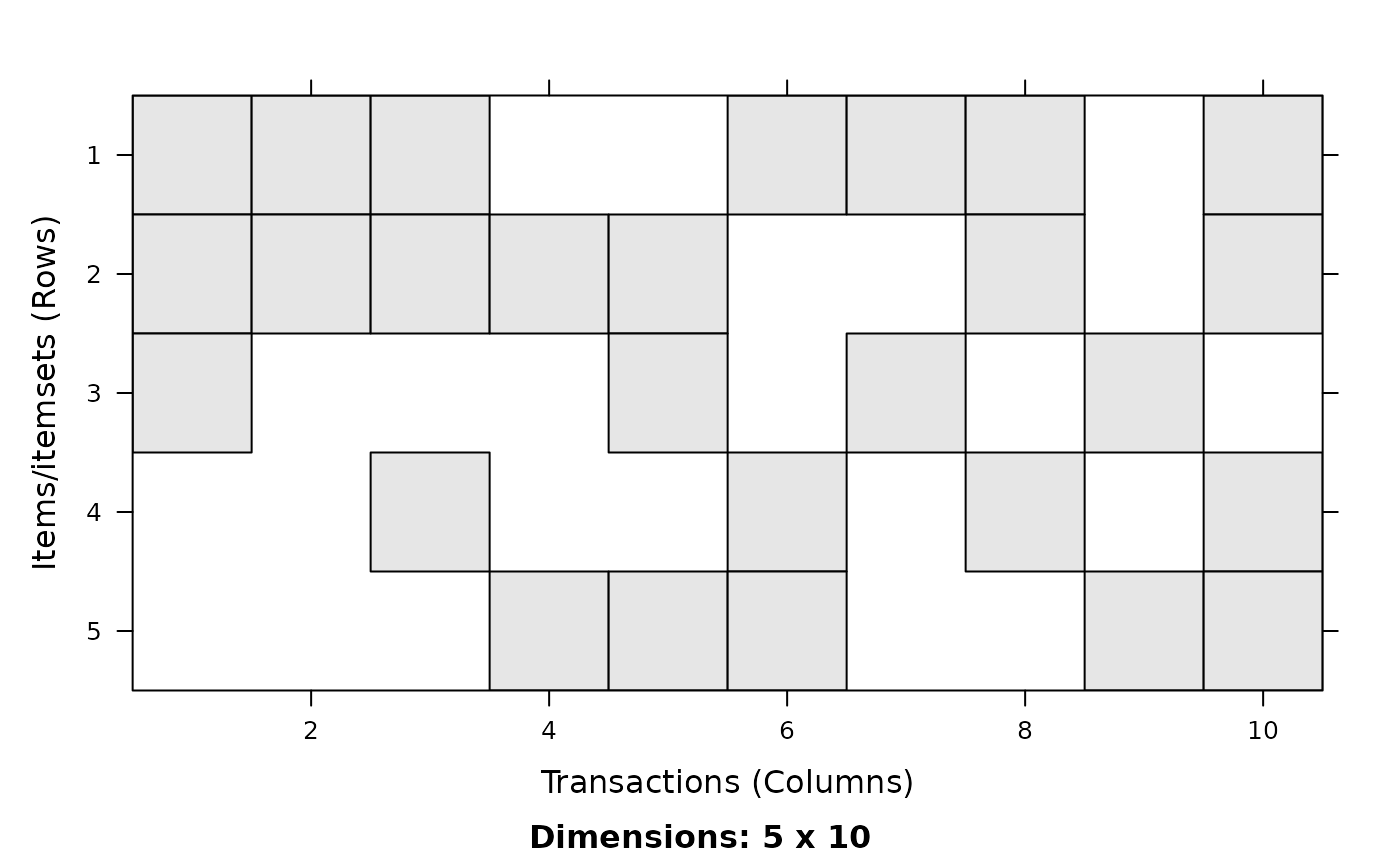
Transaction ID lists contains a set of lists. Each list is associated with an item/itemset and stores the IDs of the transactions which support the item/itemset.
tidLists uses the class
Matrix::ngCMatrix to efficiently store the
transaction ID lists as a sparse matrix. Each column in the matrix
represents one transaction ID list.
tidLists can be used for different purposes. For some operations
(e.g., support counting) it is efficient to coerce a
transactions database into tidLists where each
list contains the transaction IDs for an item (and the support is given by
the length of the list).
The implementation of the Eclat mining algorithm (which uses transaction ID list intersection) can also produce transaction ID lists for the found itemsets as part of the returned itemsets object. These lists can then be used for further computation.
Functions
summary(tidLists): create a summarydim(tidLists): get dimensions. The rows represent the itemsets and the columns are the transactions.dimnames(tidLists): get dimnamesdimnames(x = tidLists) <- value: replace dimnameslength(tidLists): get the number of itemsets.t(tidLists): this object is not transposable.t()results in an error.transactionInfo(tidLists): get the transaction info data.frametransactionInfo(tidLists) <- value: replace the the transaction info data.frameitemInfo(tidLists): get the item info data.frameitemInfo(tidLists) <- value: replace the item info data.frameitemLabels(tidLists): get the item labelslabels(tidLists): convert the tid lists into a text representation.
Slots
dataan object of class Matrix::ngCMatrix.
itemInfoa data.frame
transactionInfoa data.frame
Objects from the Class
Objects are created
as part of the itemsets mined by
eclat()withtidLists = TRUEin the ECparameter object.by coercion from an object of class transactions.
by calls of the form
new("tidLists", ...).
Coercions
as("tidLists", "list")as("list", "tidLists")as("tidLists", "ngCMatrix")as("tidLists", "transactions")as("transactions", "tidLists")as("tidLists", "itemMatrix")as("itemMatrix", "tidLists")
See also
Other itemMatrix and transactions functions:
abbreviate(),
c,
crossTable(),
duplicated(),
extract,
hierarchy,
image,
inspect(),
is.superset(),
itemFrequency(),
itemFrequencyPlot(),
itemMatrix-class,
itemwiseSetOps,
match(),
merge(),
random.transactions(),
sample(),
sets,
size(),
supportingTransactions(),
transactions-class,
unique()
Examples
## Create transaction data set.
data <- list(
c("a", "b", "c"),
c("a", "b"),
c("a", "b", "d"),
c("b", "e"),
c("b", "c", "e"),
c("a", "d", "e"),
c("a", "c"),
c("a", "b", "d"),
c("c", "e"),
c("a", "b", "d", "e")
)
data <- as(data, "transactions")
data
#> transactions in sparse format with
#> 10 transactions (rows) and
#> 5 items (columns)
## convert transactions to transaction ID lists
tl <- as(data, "tidLists")
tl
#> tidLists in sparse format with
#> 5 items/itemsets (rows) and
#> 10 transactions (columns)
inspect(tl)
#> items transactionIDs
#> 1 a {1,2,3,6,7,8,10}
#> 2 b {1,2,3,4,5,8,10}
#> 3 c {1,5,7,9}
#> 4 d {3,6,8,10}
#> 5 e {4,5,6,9,10}
dim(tl)
#> [1] 5 10
dimnames(tl)
#> [[1]]
#> [1] "a" "b" "c" "d" "e"
#>
#> [[2]]
#> NULL
#>
## inspect visually
image(tl)
 ## mine itemsets with transaction ID lists
f <- eclat(data, parameter = list(support = 0, tidLists = TRUE))
#> Eclat
#>
#> parameter specification:
#> tidLists support minlen maxlen target ext
#> TRUE 0 1 10 frequent itemsets TRUE
#>
#> algorithmic control:
#> sparse sort verbose
#> 7 -2 TRUE
#>
#> Absolute minimum support count: 0
#>
#> create itemset ...
#> set transactions ...[5 item(s), 10 transaction(s)] done [0.00s].
#> sorting and recoding items ... [5 item(s)] done [0.00s].
#> creating bit matrix ... [5 row(s), 10 column(s)] done [0.00s].
#> writing ... [21 set(s)] done [0.00s].
#> Creating S4 object ... done [0.00s].
tl2 <- tidLists(f)
inspect(tl2)
#> items transactionIDs
#> 1 {b,c,e} {5}
#> 2 {a,b,c} {1}
#> 3 {a,c} {1,7}
#> 4 {b,c} {1,5}
#> 5 {c,e} {5,9}
#> 6 {a,b,d,e} {10}
#> 7 {a,d,e} {6,10}
#> 8 {b,d,e} {10}
#> 9 {a,b,d} {3,8,10}
#> 10 {a,d} {3,6,8,10}
#> 11 {b,d} {3,8,10}
#> 12 {d,e} {6,10}
#> 13 {a,b,e} {10}
#> 14 {a,e} {6,10}
#> 15 {b,e} {4,5,10}
#> 16 {a,b} {1,2,3,8,10}
#> 17 {a} {1,2,3,6,7,8,10}
#> 18 {b} {1,2,3,4,5,8,10}
#> 19 {e} {4,5,6,9,10}
#> 20 {d} {3,6,8,10}
#> 21 {c} {1,5,7,9}
## mine itemsets with transaction ID lists
f <- eclat(data, parameter = list(support = 0, tidLists = TRUE))
#> Eclat
#>
#> parameter specification:
#> tidLists support minlen maxlen target ext
#> TRUE 0 1 10 frequent itemsets TRUE
#>
#> algorithmic control:
#> sparse sort verbose
#> 7 -2 TRUE
#>
#> Absolute minimum support count: 0
#>
#> create itemset ...
#> set transactions ...[5 item(s), 10 transaction(s)] done [0.00s].
#> sorting and recoding items ... [5 item(s)] done [0.00s].
#> creating bit matrix ... [5 row(s), 10 column(s)] done [0.00s].
#> writing ... [21 set(s)] done [0.00s].
#> Creating S4 object ... done [0.00s].
tl2 <- tidLists(f)
inspect(tl2)
#> items transactionIDs
#> 1 {b,c,e} {5}
#> 2 {a,b,c} {1}
#> 3 {a,c} {1,7}
#> 4 {b,c} {1,5}
#> 5 {c,e} {5,9}
#> 6 {a,b,d,e} {10}
#> 7 {a,d,e} {6,10}
#> 8 {b,d,e} {10}
#> 9 {a,b,d} {3,8,10}
#> 10 {a,d} {3,6,8,10}
#> 11 {b,d} {3,8,10}
#> 12 {d,e} {6,10}
#> 13 {a,b,e} {10}
#> 14 {a,e} {6,10}
#> 15 {b,e} {4,5,10}
#> 16 {a,b} {1,2,3,8,10}
#> 17 {a} {1,2,3,6,7,8,10}
#> 18 {b} {1,2,3,4,5,8,10}
#> 19 {e} {4,5,6,9,10}
#> 20 {d} {3,6,8,10}
#> 21 {c} {1,5,7,9}