
Creates an evolving DSD consisting of several MGCs, each representing a moving cluster.
Usage
DSD_MG(dimension = 2, ..., labels = NULL, description = NULL)

add_cluster(x, c, label = NULL)

get_clusters(x)

remove_cluster(x, i)

# S3 method for class 'DSD_MG'
add_cluster(x, c, label = NULL)
Arguments
- dimension
the dimension of the DSD object
- ...
initial set of MGCs
- description
An optional string used by
print()to describe the data generator.- x
A
DSD_MGobject.- c
The cluster that should be added to the
DSD_MGobject.- label, labels
integer representing the cluster label.
NArepresents noise. If labels are not specified, then each new cluster gets a new label.- i
The index of the cluster that should be removed from the
DSD_MGobject.
Details
This DSD is able to generate complex datasets that are able to evolve over a period of time. Its behavior is determined by a set of MGCs, each representing a moving cluster.
See also
MGC for types of moving clusters.
Other DSD:
DSD(),
DSD_BarsAndGaussians(),
DSD_Benchmark(),
DSD_Cubes(),
DSD_Gaussians(),
DSD_Memory(),
DSD_Mixture(),
DSD_NULL(),
DSD_ReadDB(),
DSD_ReadStream(),
DSD_Target(),
DSD_UniformNoise(),
DSD_mlbenchData(),
DSD_mlbenchGenerator(),
DSF(),
animate_data(),
close_stream(),
get_points(),
plot.DSD(),
reset_stream()
Examples
### create an empty DSD_MG
stream <- DSD_MG(dimension = 2)
stream
#> Moving Data GeneratorClass: DSD_MG, DSD_R, DSD
#> With 0 clusters in 2 dimensions. Time is 1
### add two clusters
c1 <- MGC_Random(density = 50, center = c(50, 50), parameter = 1)
add_cluster(stream, c1)
stream
#> Moving Data GeneratorClass: DSD_MG, DSD_R, DSD
#> With 1 clusters in 2 dimensions. Time is 1
c2 <- MGC_Noise(density = 1, range = rbind(c(-20, 120), c(-20, 120)))
add_cluster(stream, c2)
stream
#> Moving Data GeneratorClass: DSD_MG, DSD_R, DSD
#> With 2 clusters in 2 dimensions. Time is 1
get_clusters(stream)
#> [[1]]
#> Random Moving Generator Cluster (MGC_Random, MGC)
#> In 2 dimensions
#>
#> [[2]]
#> Noise (MGC_Noise, MGC)
#> In 2 dimensions
#>
get_points(stream, n = 5)
#> X1 X2 .class
#> 1 50.35411 49.89896 1
#> 2 51.41467 49.49134 1
#> 3 49.97374 49.07762 1
#> 4 49.59217 48.48719 1
#> 5 50.25441 51.56740 1
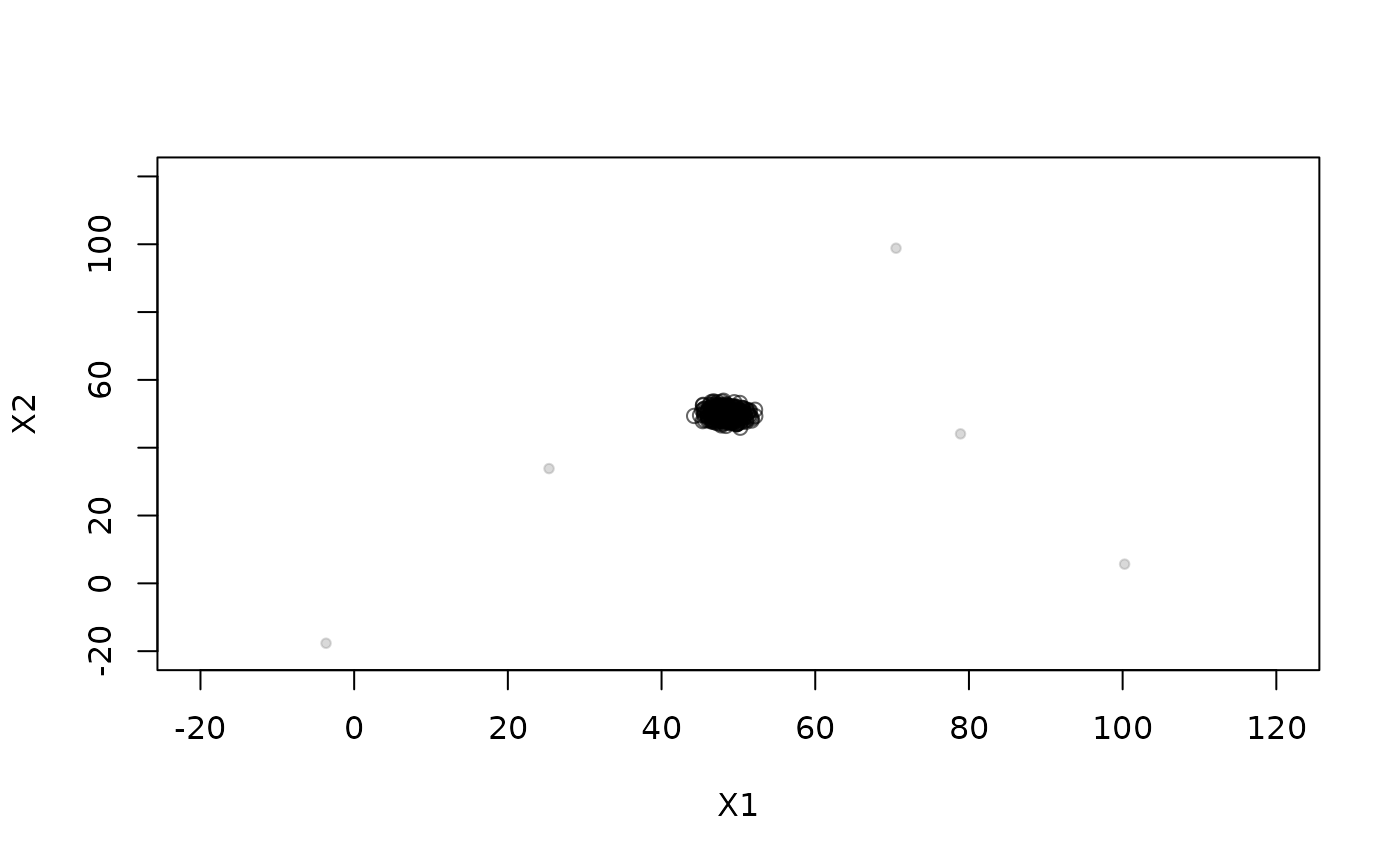
plot(stream, xlim = c(-20,120), ylim = c(-20, 120))
 if (interactive()) {
animate_data(stream, n = 5000, xlim = c(-20, 120), ylim = c(-20, 120))
}
### remove cluster 1
remove_cluster(stream, 1)
stream
#> Moving Data GeneratorClass: DSD_MG, DSD_R, DSD
#> With 1 clusters in 2 dimensions. Time is 10.902
get_clusters(stream)
#> [[1]]
#> Noise (MGC_Noise, MGC)
#> In 2 dimensions
#>
plot(stream, xlim = c(-20, 120), ylim = c(-20, 120))
if (interactive()) {
animate_data(stream, n = 5000, xlim = c(-20, 120), ylim = c(-20, 120))
}
### remove cluster 1
remove_cluster(stream, 1)
stream
#> Moving Data GeneratorClass: DSD_MG, DSD_R, DSD
#> With 1 clusters in 2 dimensions. Time is 10.902
get_clusters(stream)
#> [[1]]
#> Noise (MGC_Noise, MGC)
#> In 2 dimensions
#>
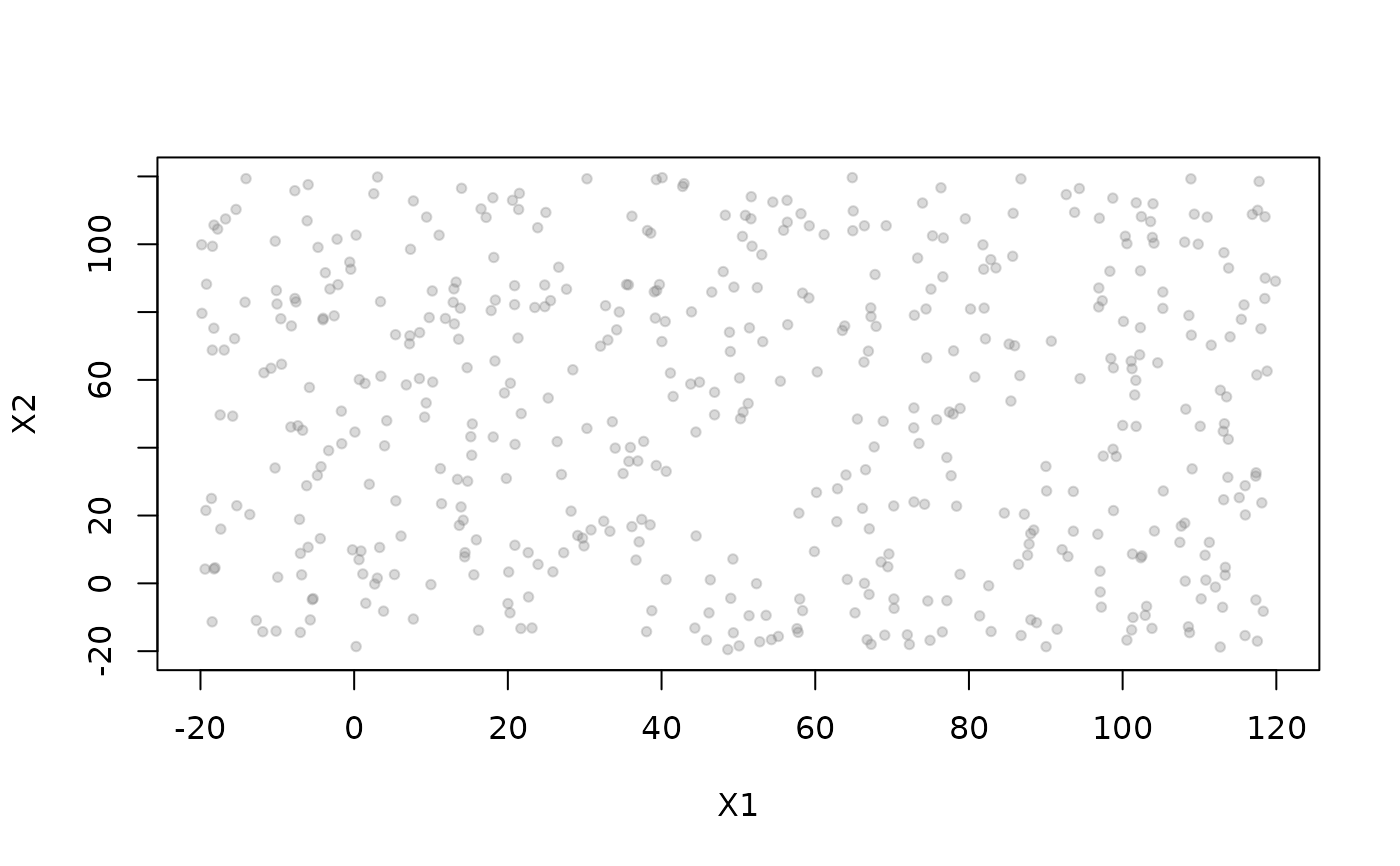
plot(stream, xlim = c(-20, 120), ylim = c(-20, 120))
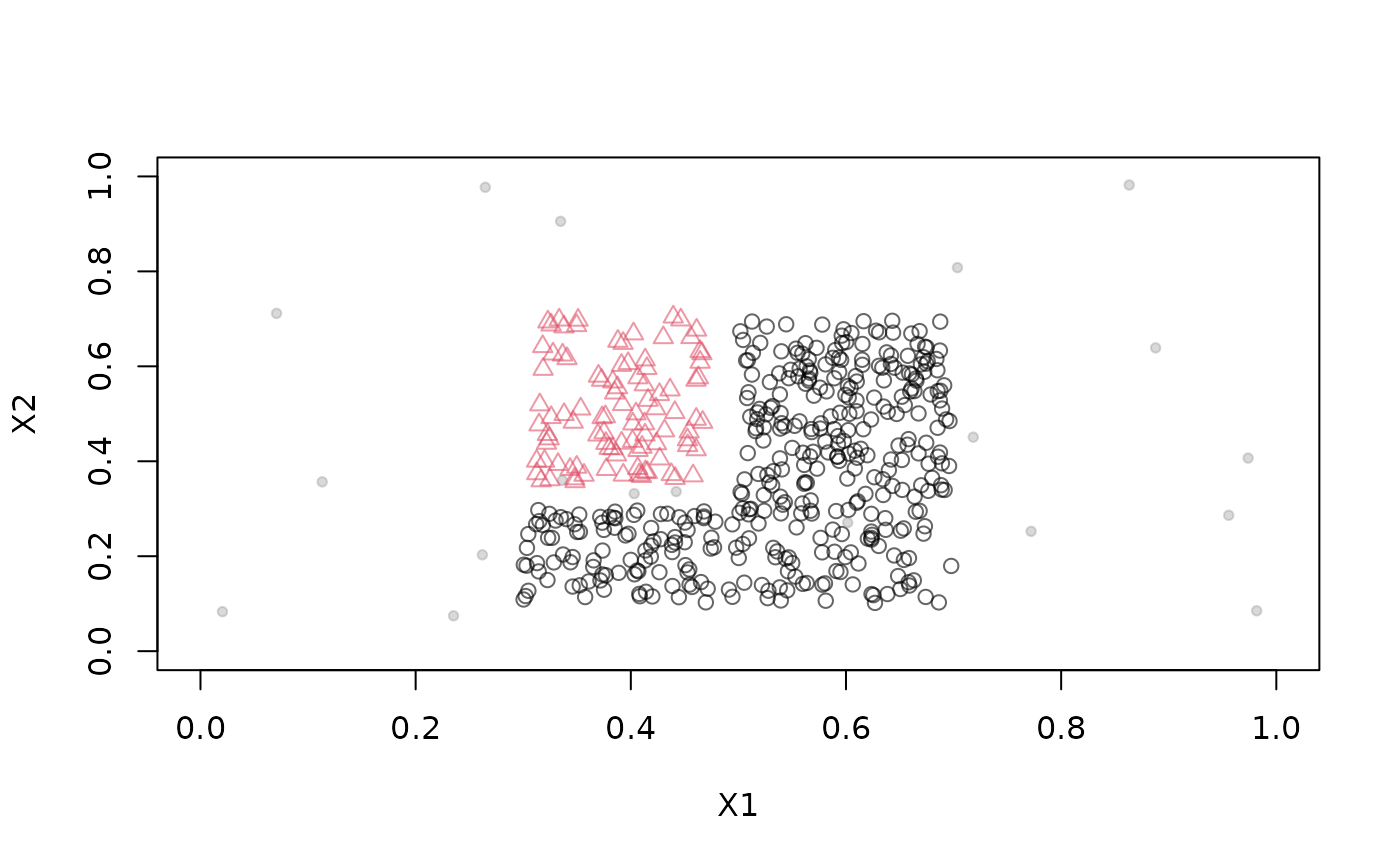
 ### create a more complicated cluster structure (using 2 clusters with the same
### label to form an L shape)
stream <- DSD_MG(dimension = 2,
MGC_Static(density = 10, center = c(.5, .2), parameter = c(.4, .2),
shape = Shape_Block),
MGC_Static(density = 10, center = c(.6, .5), parameter = c(.2, .4),
shape = Shape_Block),
MGC_Static(density = 5, center = c(.39, .53), parameter = c(.16, .35),
shape = Shape_Block),
MGC_Noise( density = 1, range = rbind(c(0,1), c(0,1))),
labels = c(1, 1, 2, NA)
)
stream
#> Moving Data GeneratorClass: DSD_MG, DSD_R, DSD
#> With 4 clusters in 2 dimensions. Time is 1
plot(stream, xlim = c(0, 1), ylim = c(0, 1))
### create a more complicated cluster structure (using 2 clusters with the same
### label to form an L shape)
stream <- DSD_MG(dimension = 2,
MGC_Static(density = 10, center = c(.5, .2), parameter = c(.4, .2),
shape = Shape_Block),
MGC_Static(density = 10, center = c(.6, .5), parameter = c(.2, .4),
shape = Shape_Block),
MGC_Static(density = 5, center = c(.39, .53), parameter = c(.16, .35),
shape = Shape_Block),
MGC_Noise( density = 1, range = rbind(c(0,1), c(0,1))),
labels = c(1, 1, 2, NA)
)
stream
#> Moving Data GeneratorClass: DSD_MG, DSD_R, DSD
#> With 4 clusters in 2 dimensions. Time is 1
plot(stream, xlim = c(0, 1), ylim = c(0, 1))
 ### simulate the clustering of a splitting cluster
c1 <- MGC_Linear(dimension = 2, keyframelist = list(
keyframe(time = 1, density = 20, center = c(0,0), parameter = 10),
keyframe(time = 50, density = 10, center = c(50,50), parameter = 10),
keyframe(time = 100,density = 10, center = c(50,100),parameter = 10)
))
### Note: The second cluster appears at time = 50
c2 <- MGC_Linear(dimension = 2, keyframelist = list(
keyframe(time = 50, density = 10, center = c(50,50), parameter = 10),
keyframe(time = 100,density = 10, center = c(100,50),parameter = 10)
))
stream <- DSD_MG(dimension = 2, c1, c2)
stream
#> Moving Data GeneratorClass: DSD_MG, DSD_R, DSD
#> With 2 clusters in 2 dimensions. Time is 1
dbstream <- DSC_DBSTREAM(r = 20, lambda = 0.1)
if (interactive()) {
purity <- animate_cluster(dbstream, stream, n = 2500, type = "micro",
xlim = c(-10, 120), ylim = c(-10, 120),
measure = "purity", horizon = 100)
}
### simulate the clustering of a splitting cluster
c1 <- MGC_Linear(dimension = 2, keyframelist = list(
keyframe(time = 1, density = 20, center = c(0,0), parameter = 10),
keyframe(time = 50, density = 10, center = c(50,50), parameter = 10),
keyframe(time = 100,density = 10, center = c(50,100),parameter = 10)
))
### Note: The second cluster appears at time = 50
c2 <- MGC_Linear(dimension = 2, keyframelist = list(
keyframe(time = 50, density = 10, center = c(50,50), parameter = 10),
keyframe(time = 100,density = 10, center = c(100,50),parameter = 10)
))
stream <- DSD_MG(dimension = 2, c1, c2)
stream
#> Moving Data GeneratorClass: DSD_MG, DSD_R, DSD
#> With 2 clusters in 2 dimensions. Time is 1
dbstream <- DSC_DBSTREAM(r = 20, lambda = 0.1)
if (interactive()) {
purity <- animate_cluster(dbstream, stream, n = 2500, type = "micro",
xlim = c(-10, 120), ylim = c(-10, 120),
measure = "purity", horizon = 100)
}