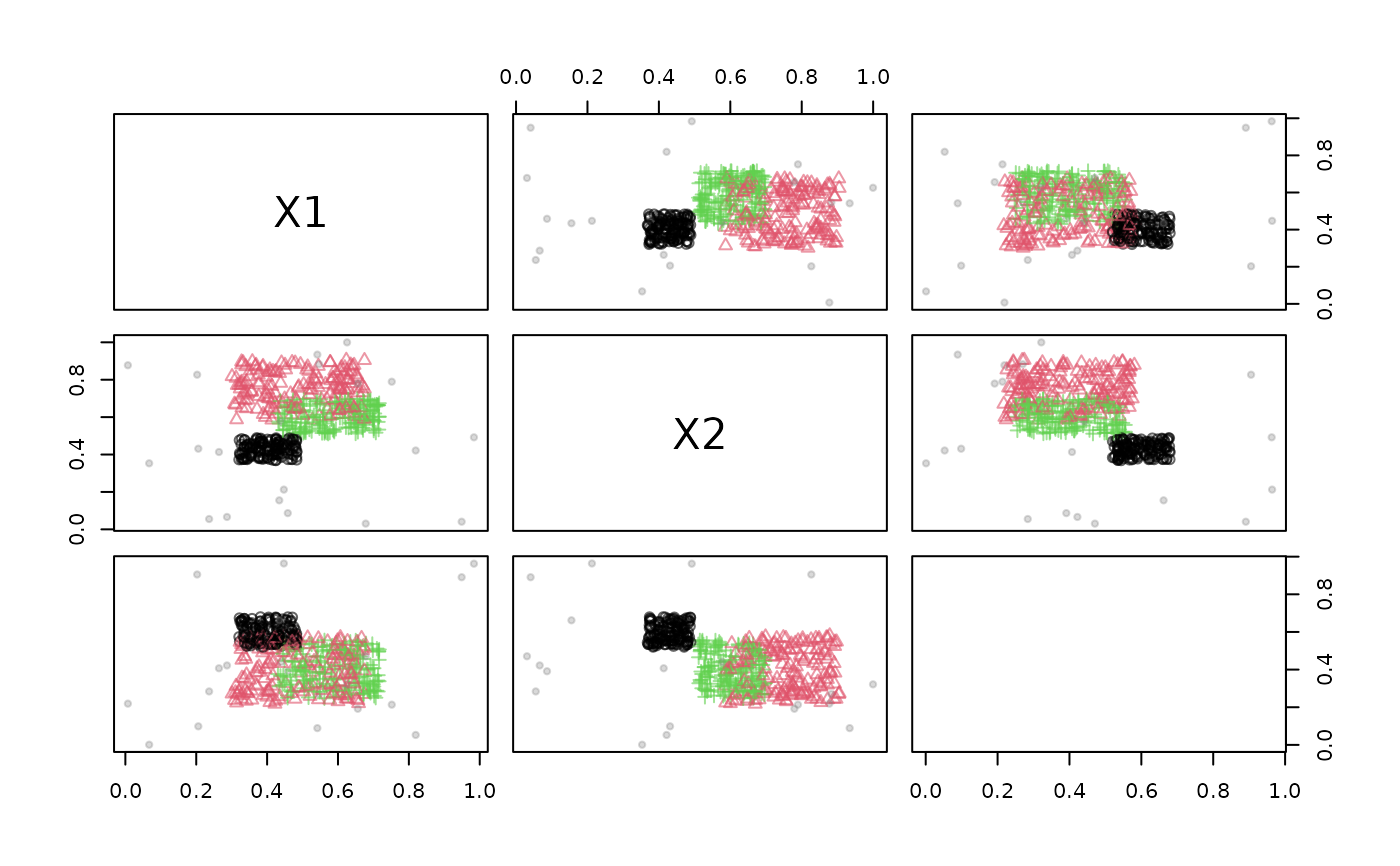
A data stream generator that produces a data stream with static (hyper) cubes filled uniformly with data points.
Arguments
- k
Determines the number of clusters.
- d
Determines the number of dimensions.
- center
A matrix of means for each dimension of each cluster.
- size
A
ktimesdmatrix with the cube dimensions.- p
A vector of probabilities that determines the likelihood of generating a data point from a particular cluster.
- noise
Noise probability between 0 and 1. Noise is uniformly distributed within noise range (see below).
- noise_range
A matrix with d rows and 2 columns. The first column contains the minimum values and the second column contains the maximum values for noise.
See also
Other DSD:
DSD(),
DSD_BarsAndGaussians(),
DSD_Benchmark(),
DSD_Gaussians(),
DSD_MG(),
DSD_Memory(),
DSD_Mixture(),
DSD_NULL(),
DSD_ReadDB(),
DSD_ReadStream(),
DSD_Target(),
DSD_UniformNoise(),
DSD_mlbenchData(),
DSD_mlbenchGenerator(),
DSF(),
animate_data(),
close_stream(),
get_points(),
plot.DSD(),
reset_stream()
Examples
# create data stream with three clusters in 3D
stream <- DSD_Cubes(k = 3, d = 3, noise = 0.05)

get_points(stream, n = 5)
#>          X1        X2      <NA> .class
#> 1 0.3200669 0.7458459 0.3692036      2
#> 2 0.6977560 0.6218788 0.4782292      3
#> 3 0.5286707 0.5140967 0.4073528      3
#> 4 0.4748724 0.4424403 0.5262905      1
#> 5 0.9297055 0.2136115 0.3842991     NA

plot(stream)