
Finds the reachable state space from an MDP or MDPSample.
Usage
reachable_states(model, ..., progress = TRUE)

# S3 method for class 'MDPModel'
reachable_states(model, horizon = Inf, ..., progress = TRUE)

# S3 method for class 'MDPSample'
reachable_states(model, n = 100, horizon = NULL, ..., progress = TRUE)

# S3 method for class '`function`'
reachable_states(
  model,
  actions,
  start_state,
  horizon = Inf,
  ...,
  progress = TRUE
)
Arguments
- model
an MDP or an MDP transition function.
- ...
further arguments are passed on (e.g., to
sample_MDP())- progress
logical; show a progress bar?
- horizon
only return states reachable in the given horizon.
- n
number if sampled trajectories.
- actions
labels of the available actions.
- start_state
label of the start state.
Details
There are three application cases for finding reachable states.
For an MDP that has a state space defined, not all specified states might be reachable. The function performs a (depth-limited) depth-first traversal of the state space and returns a vector with the names of all encountered states. This is used for example for
unreachable_states().We may only have a transition model function following the specifications of an R transition function for an MDPModel which returns a probability distribution over state transitions. To create a complete MDP, we can use the found reachable states to create a complete MDP object. This search also used depth-first search of the state space.
To use tabular methods for MDPSample which specify a transition function that returns the reward and the next state, we need to also specify the state space. Since an MDPSample can have a stochastic transition model, trajectory sampling is used. The horizon and the number of trajectories
nhas to be specified.Notes:
Not all reachable states may be returned if some states have a very low probability to be in the sample trajectories.
A finite horizon is needed for sampling. By default the model horizon is used. Infinite horizon is capped at 1000. Larger values can be specified manually.
See also
Other MDP:
MDP(),
absorbing_states(),
act(),
action_state_helpers,
available_actions(),
find_reachable_states(),
sample_MDP(),
sample_MDP.MDPSample(),
start,
transition_graph(),
transition_matrix(),
unreachable_states()
Other MDPSample:
MDPSample(),
absorbing_states(),
act(),
action_state_helpers,
sample_MDP.MDPSample(),
solve_MDP_PG(),
start
Examples
# Example 1: Find the reachable states of a simple MDP with only sample access
line_maze <- MDPSample(actions = c("left", "right"),
start = s(0),
absorbing_states = rbind(s(-10), s(10)),
transition_model = function(model, action, state) {
if (state == s(-10) || state == s(+10)) {
return(list(reward = 0, state_prime = state))
}
reward <- 0
if (action == "left") state <- state - 1
if (action == "right") state <- state + 1
if (state == s(-10) || state == s(+10)) {
reward <- 10
}
return(list(reward = reward, state_prime = state))
},
name = "line maze [-10,+10]"
)
# this model has no state specified
line_maze
#> MDPSample, MDP - line maze [-10,+10]
#> Discount factor: 0.9
#> Horizon: Inf epochs
#> Size: 2 actions / undefined state space
#> Start: s(0)
#> List components: ‘name’, ‘discount’, ‘horizon’, ‘actions’, ‘states’,
#> ‘start’, ‘absorbing_states’, ‘transition_model’, ‘info’
S(line_maze)
#> NULL
# find the states
states <- reachable_states(line_maze, horizon = 100)
states
#> [1] "s(-1)" "s(-10)" "s(-2)" "s(-3)" "s(-4)" "s(-5)" "s(-6)" "s(-7)"
#> [9] "s(-8)" "s(-9)" "s(0)" "s(1)" "s(10)" "s(2)" "s(3)" "s(4)"
#> [17] "s(5)" "s(6)" "s(7)" "s(8)" "s(9)"
# set the states in the model
line_maze$states <- states
line_maze
#> MDPSample, MDP - line maze [-10,+10]
#> Discount factor: 0.9
#> Horizon: Inf epochs
#> Size: 2 actions / 21 states
#> Start: s(0)
#> List components: ‘name’, ‘discount’, ‘horizon’, ‘actions’, ‘states’,
#> ‘start’, ‘absorbing_states’, ‘transition_model’, ‘info’
sol <- solve_MDP(line_maze, method = "TD:q_learning",
horizon = 100, n = 100, epsilon = .8)
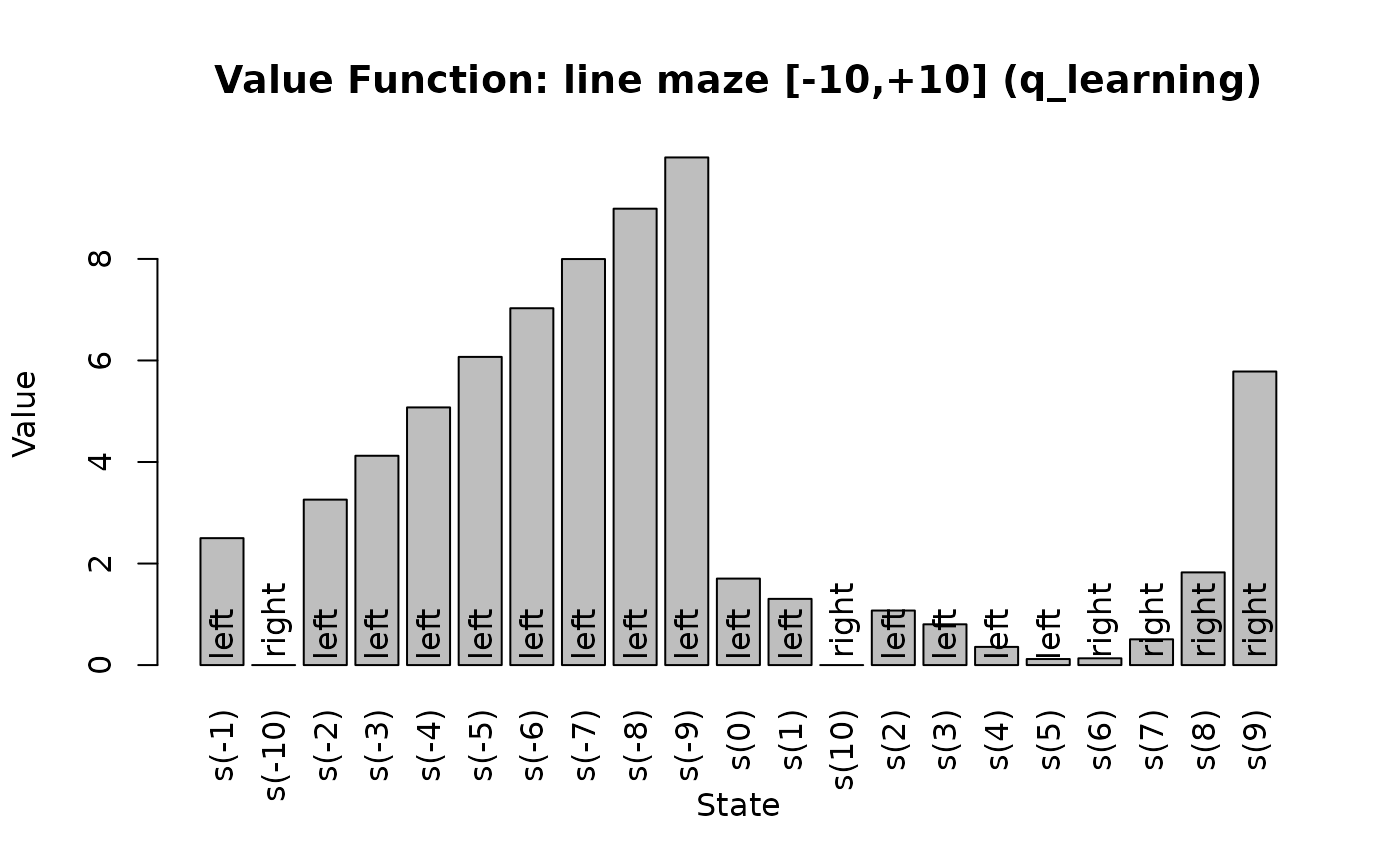
policy(sol)
#> state V action
#> 1 s(-1) 2.5001888 left
#> 2 s(-10) 0.0000000 right
#> 3 s(-2) 3.2589494 left
#> 4 s(-3) 4.1230376 left
#> 5 s(-4) 5.0752757 left
#> 6 s(-5) 6.0703161 left
#> 7 s(-6) 7.0287817 left
#> 8 s(-7) 7.9976524 left
#> 9 s(-8) 8.9895388 left
#> 10 s(-9) 9.9990328 left
#> 11 s(0) 1.7037361 left
#> 12 s(1) 1.3041920 left
#> 13 s(10) 0.0000000 right
#> 14 s(2) 1.0743627 left
#> 15 s(3) 0.8032204 left
#> 16 s(4) 0.3581580 left
#> 17 s(5) 0.1192231 left
#> 18 s(6) 0.1333712 right
#> 19 s(7) 0.5072045 right
#> 20 s(8) 1.8258678 right
#> 21 s(9) 5.7824847 right
plot_value_function(sol)
 # Example 2: Find the states to define an MDP for Tic-Tac-Toe
# state description: matrix with the characters _, x, and o
# can be converted into a label of 9 characters
# set of actions
A <- as.character(1:9)
# helper functions
ttt_empty_board <- function() matrix('_', ncol = 3, nrow = 3)
ttt_state2label <- function(state) paste(state, collapse = '')
ttt_label2state <- function(label) matrix(strsplit(label, "")[[1]],
nrow = 3, ncol = 3)
ttt_available_actions <- function(state) {
if (length(state) == 1L) state <- ttt_label2state(state)
which(state == "_")
}
ttt_result <- function(state, player, action) {
if (length(state) == 1L) state <- ttt_label2state(state)
if (state[action] != "_")
stop("Illegal action.")
state[action] <- player
state
}
ttt_terminal <- function(state) {
if (length(state) == 1L) state <- ttt_label2state(state)
# Check the board for a win and return one of
# 'x', 'o', 'd' (draw), or 'n' (for next move)
win_possibilities <- rbind(state,
t(state),
diag(state),
diag(t(state)))
wins <- apply(win_possibilities, MARGIN = 1, FUN = function(x) {
if (x[1] != '_' && length(unique(x)) == 1) x[1]
else '_'
})
if (any(wins == 'x'))
return('x')
if (any(wins == 'o'))
return('o')
# Check for draw
if (sum(state == '_') < 1)
return('d')
return('n')
}
# define the transition function:
# * return a probability vector for an action in a start state
# * we define the special states 'win', 'loss', and 'draw'
P <- function(model, action, start.state) {
action <- as.integer(action)
# absorbing states
if (start.state %in% c('win', 'loss', 'draw', 'illegal')) {
return(structure(1, names = start.state))
}
# avoid illegal action by going to the very expensive illegal state
if (!(action %in% ttt_available_actions(start.state))) {
return(structure(1, names = "illegal"))
}
# make x's move
next_state <- ttt_result(start.state, 'x', action)
# terminal?
term <- ttt_terminal(next_state)
if (term == 'x') {
return(structure(1, names = "win"))
} else if (term == 'o') {
return(structure(1, names = "loss"))
} else if (term == 'd') {
return(structure(1, names = "draw"))
}
# it is o's turn
actions_of_o <- ttt_available_actions(next_state)
possible_end_states <- lapply(
actions_of_o,
FUN = function(a)
ttt_result(next_state, 'o', a)
)
# fix terminal states
term <- sapply(possible_end_states, ttt_terminal)
possible_end_states <- sapply(possible_end_states, ttt_state2label)
possible_end_states[term == 'x'] <- 'win'
possible_end_states[term == 'o'] <- 'loss'
possible_end_states[term == 'd'] <- 'draw'
possible_end_states <- unique(possible_end_states)
return(structure(rep(1 / length(possible_end_states),
length(possible_end_states)),
names = possible_end_states))
}
# define the reward
R <- rbind(
R_( value = 0),
R_(end.state = 'win', value = +1),
R_(end.state = 'loss', value = -1),
R_(end.state = 'draw', value = +.5),
R_(end.state = 'illegal', value = -Inf),
# Note: there is no more reward once the agent is in a terminal state
R_(start.state = 'win', value = 0),
R_(start.state = 'loss', value = 0),
R_(start.state = 'draw', value = 0),
R_(start.state = 'illegal', value = 0)
)
# start state
start <- ttt_state2label(ttt_empty_board())
start
#> [1] "_________"
# find the reachable state space
S <- union(c('win', 'loss', 'draw', 'illegal'),
reachable_states(P, start_state = start, actions = A))
head(S)
#> [1] "win" "loss" "draw" "illegal" "xoxo_ox__" "xoxoo_xxo"
tictactoe <- MDP(S, A, P, R, discount = 1, start = start, name = "TicTacToe")
tictactoe
#> MDPModel, MDP - TicTacToe
#> Discount factor: 1
#> Horizon: Inf epochs
#> Size: 9 actions / 2527 states
#> Storage: transition prob as function / reward as data.frame. Total size: 201.3 Kb
#> Start: _________
#> Model list components: ‘name’, ‘discount’, ‘horizon’, ‘states’,
#> ‘actions’, ‘start’, ‘transition_model’, ‘reward’, ‘info’
# this MDP takes about 30 seconds to solve using value iteration
# sol <- solve_MDP(tictactoe)
# policy(sol)[1:10, ]
# Example 2: Find the states to define an MDP for Tic-Tac-Toe
# state description: matrix with the characters _, x, and o
# can be converted into a label of 9 characters
# set of actions
A <- as.character(1:9)
# helper functions
ttt_empty_board <- function() matrix('_', ncol = 3, nrow = 3)
ttt_state2label <- function(state) paste(state, collapse = '')
ttt_label2state <- function(label) matrix(strsplit(label, "")[[1]],
nrow = 3, ncol = 3)
ttt_available_actions <- function(state) {
if (length(state) == 1L) state <- ttt_label2state(state)
which(state == "_")
}
ttt_result <- function(state, player, action) {
if (length(state) == 1L) state <- ttt_label2state(state)
if (state[action] != "_")
stop("Illegal action.")
state[action] <- player
state
}
ttt_terminal <- function(state) {
if (length(state) == 1L) state <- ttt_label2state(state)
# Check the board for a win and return one of
# 'x', 'o', 'd' (draw), or 'n' (for next move)
win_possibilities <- rbind(state,
t(state),
diag(state),
diag(t(state)))
wins <- apply(win_possibilities, MARGIN = 1, FUN = function(x) {
if (x[1] != '_' && length(unique(x)) == 1) x[1]
else '_'
})
if (any(wins == 'x'))
return('x')
if (any(wins == 'o'))
return('o')
# Check for draw
if (sum(state == '_') < 1)
return('d')
return('n')
}
# define the transition function:
# * return a probability vector for an action in a start state
# * we define the special states 'win', 'loss', and 'draw'
P <- function(model, action, start.state) {
action <- as.integer(action)
# absorbing states
if (start.state %in% c('win', 'loss', 'draw', 'illegal')) {
return(structure(1, names = start.state))
}
# avoid illegal action by going to the very expensive illegal state
if (!(action %in% ttt_available_actions(start.state))) {
return(structure(1, names = "illegal"))
}
# make x's move
next_state <- ttt_result(start.state, 'x', action)
# terminal?
term <- ttt_terminal(next_state)
if (term == 'x') {
return(structure(1, names = "win"))
} else if (term == 'o') {
return(structure(1, names = "loss"))
} else if (term == 'd') {
return(structure(1, names = "draw"))
}
# it is o's turn
actions_of_o <- ttt_available_actions(next_state)
possible_end_states <- lapply(
actions_of_o,
FUN = function(a)
ttt_result(next_state, 'o', a)
)
# fix terminal states
term <- sapply(possible_end_states, ttt_terminal)
possible_end_states <- sapply(possible_end_states, ttt_state2label)
possible_end_states[term == 'x'] <- 'win'
possible_end_states[term == 'o'] <- 'loss'
possible_end_states[term == 'd'] <- 'draw'
possible_end_states <- unique(possible_end_states)
return(structure(rep(1 / length(possible_end_states),
length(possible_end_states)),
names = possible_end_states))
}
# define the reward
R <- rbind(
R_( value = 0),
R_(end.state = 'win', value = +1),
R_(end.state = 'loss', value = -1),
R_(end.state = 'draw', value = +.5),
R_(end.state = 'illegal', value = -Inf),
# Note: there is no more reward once the agent is in a terminal state
R_(start.state = 'win', value = 0),
R_(start.state = 'loss', value = 0),
R_(start.state = 'draw', value = 0),
R_(start.state = 'illegal', value = 0)
)
# start state
start <- ttt_state2label(ttt_empty_board())
start
#> [1] "_________"
# find the reachable state space
S <- union(c('win', 'loss', 'draw', 'illegal'),
reachable_states(P, start_state = start, actions = A))
head(S)
#> [1] "win" "loss" "draw" "illegal" "xoxo_ox__" "xoxoo_xxo"
tictactoe <- MDP(S, A, P, R, discount = 1, start = start, name = "TicTacToe")
tictactoe
#> MDPModel, MDP - TicTacToe
#> Discount factor: 1
#> Horizon: Inf epochs
#> Size: 9 actions / 2527 states
#> Storage: transition prob as function / reward as data.frame. Total size: 201.3 Kb
#> Start: _________
#> Model list components: ‘name’, ‘discount’, ‘horizon’, ‘states’,
#> ‘actions’, ‘start’, ‘transition_model’, ‘reward’, ‘info’
# this MDP takes about 30 seconds to solve using value iteration
# sol <- solve_MDP(tictactoe)
# policy(sol)[1:10, ]