Constructor to create an instance of the asymmetric traveling salesperson problem (ATSP) and some auxiliary methods.
Usage
ATSP(x, labels = NULL, method = NULL)

as.ATSP(x)

# S3 method for class 'matrix'
as.ATSP(x)

# S3 method for class 'dist'
as.ATSP(x)

# S3 method for class 'ATSP'
print(x, ...)

# S3 method for class 'ATSP'
n_of_cities(x)

# S3 method for class 'ATSP'
labels(object, ...)

# S3 method for class 'ATSP'
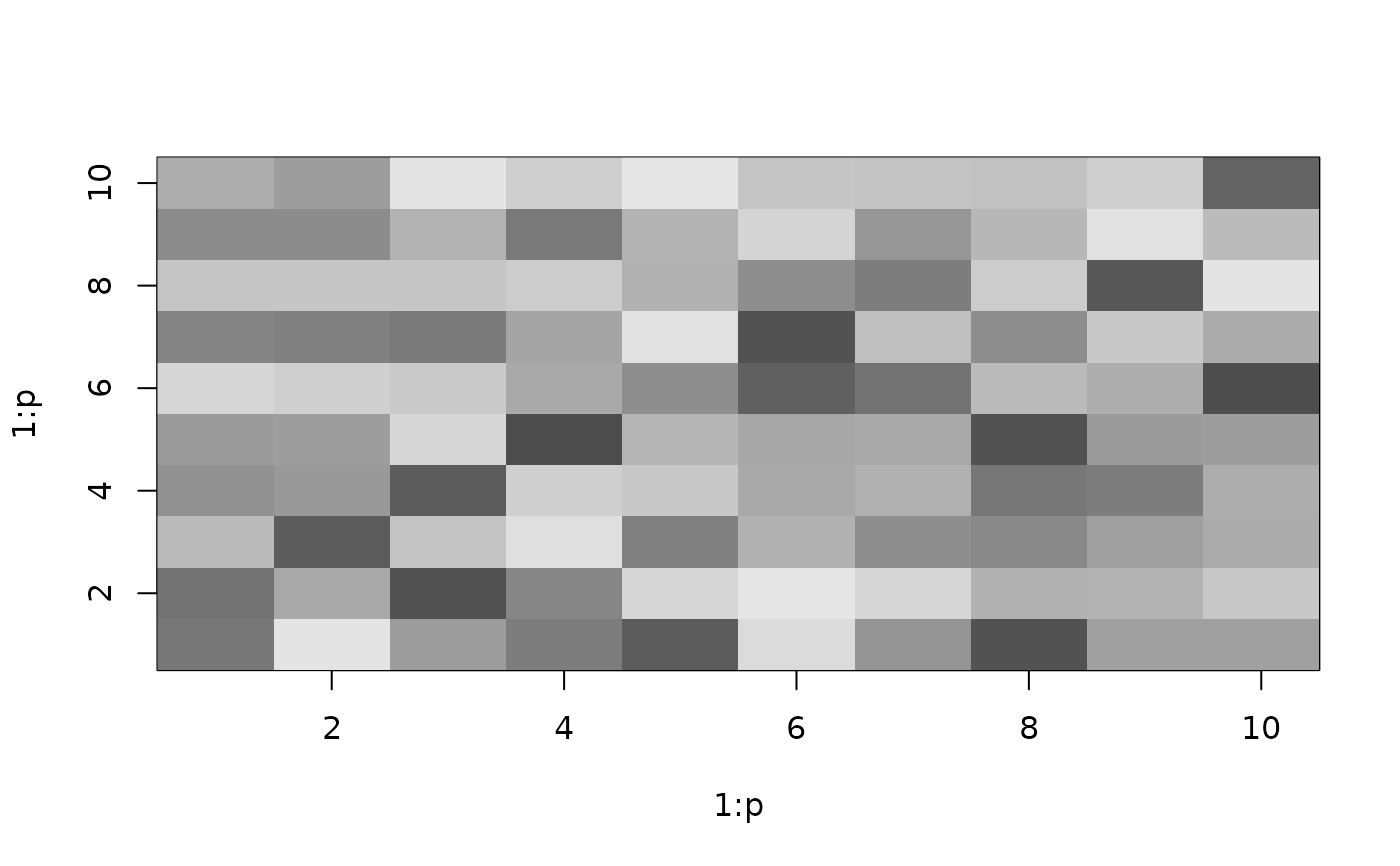
image(x, order, col = gray.colors(64), ...)

# S3 method for class 'ATSP'
as.matrix(x, ...)
Arguments
- x, object
an object (a square matrix) to be converted into an
ATSPor, for the methods, an object of classATSP.- labels
optional city labels. If not given, labels are taken from
x.- method
optional name of the distance metric.
- ...
further arguments are passed on.
- order
order of cities as an integer vector or an object of class
TOUR.- col
color scheme for image.
Value
ATSP()returnsxas an object of classATSP.n_of_cities()returns the number of cities inx.labels()returns a vector with the names of the cities inx.
Details
Objects of class ATSP are internally represented by a matrix (use
as.matrix() to get just the matrix).
ATSPs can be transformed into (larger) symmetric TSPs using
reformulate_ATSP_as_TSP().
See also
Other TSP:
ETSP(),
TSP(),
insert_dummy(),
reformulate_ATSP_as_TSP()
Examples
data <- matrix(runif(10^2), ncol = 10, dimnames = list(1:10, 1:10))

atsp <- ATSP(data)
atsp
#> object of class ‘ATSP’  (asymmetric TSP)
#> 10 cities (distance ‘unknown’)

## use some methods
n_of_cities(atsp)
#> [1] 10
labels(atsp)
#>  [1] "1"  "2"  "3"  "4"  "5"  "6"  "7"  "8"  "9"  "10"

## calculate a tour
tour <- solve_TSP(atsp, method = "nn")
tour
#> object of class ‘TOUR’
#> result of method ‘nn’ for 10 cities
#> tour length: 2.551933

tour_length(tour)
#> [1] 2.551933

image(atsp, tour)