
Publish a Data Stream Clustering Task via a Web Service
Source:R/publish_DSC_via_WebService.R
publish_DSC_via_WebService.RdUses the package plumber to publish a data stream task as a web service.
Usage
publish_DSC_via_WebService(
  dsc,
  port,
  task_file = NULL,
  serializer = "csv",
  serve = TRUE,
  background = TRUE,
  debug = FALSE
)
Arguments
- dsc
A character string that creates a DSC.
- port
port used to serve the task.
- task_file
name of the plumber task script file.
- serializer
method used to serialize the data. By default,
csv(comma-separated values) is used. Other methods arejsonandrds(see plumber::serializer_csv).- serve
if
TRUE, then a task file is written and a server started, otherwise, only a plumber task file is written.- background
logical; start a background process?
- debug
if
TRUE, then the service is started locally and a web client is started to explore the interface.
Value
a processx::process object created with callr::r_bg() which runs the plumber server
in the background. The process can be stopped with rp$kill() or by killing the process
using the operating system with the appropriate PID. rp$get_result() can
be used to check for errors in the server process (e.g., when it terminates
unexpectedly).
Details
The function writes a plumber task script file and starts the web server to serve the content of the stream using the endpoints
GET
/infoPOST
/updaterequires the data to be uploaded as a file in csv format (see Examples section).GET
/get_centerswith parametertype(seestream::get_centers()).GET
/get_weightswith parametertype(seestream::get_weights()).
Supported serializers are csv (default), json, and rds.
APIs generated using plumber can be easily deployed. See: Hosting. By setting a task_file and serve = FALSE a plumber
task script file is generated for deployment.
See also
Other WebService:
DSC_WebService(),
DSD_ReadWebService(),
publish_DSD_via_WebService()
Other dsc:
DSC_WebService()
Examples
# find a free port
port <- httpuv::randomPort()
port
#> [1] 19558
# Deploy a clustering process listening for data on the port
rp1 <- publish_DSC_via_WebService("DSC_DBSTREAM(r = .05)", port = port)
rp1
#> PROCESS 'R', running, pid 8050.
# look at ? DSC_WebService for a convenient interface.
# Here we we show how to connect to the port and send data manually.
library(httr)
#>
#> Attaching package: ‘httr’
#> The following object is masked from ‘package:stream’:
#>
#> write_stream
# the info verb returns some basic information about the clusterer.
resp <- RETRY("GET", paste0("http://localhost:", port, "/info"))
d <- content(resp, show_col_types = FALSE)
d
#> # A tibble: 1 × 3
#> description class clusters
#> <chr> <chr> <dbl>
#> 1 DBSTREAM DSC_DBSTREAM, DSC_Micro, DSC_R, DSC 0
# create a local data stream and send it to the clusterer using the update verb.
dsd <- DSD_Gaussians(k = 3, d = 2, noise = 0.05)
tmp <- tempfile()
stream::write_stream(dsd, tmp, n = 500, header = TRUE)
resp <- POST(paste0("http://localhost:", port, "/update"),
body = list(upload = upload_file(tmp)))
unlink(tmp)
resp
#> Response [http://localhost:19558/update]
#> Date: 2026-10-04 23:09
#> Status: 200
#> Content-Type: text/csv; charset=UTF-8
#> Size: 17 B
#> result
#> Update OK
# retrieve the cluster centers using the get_centers verb
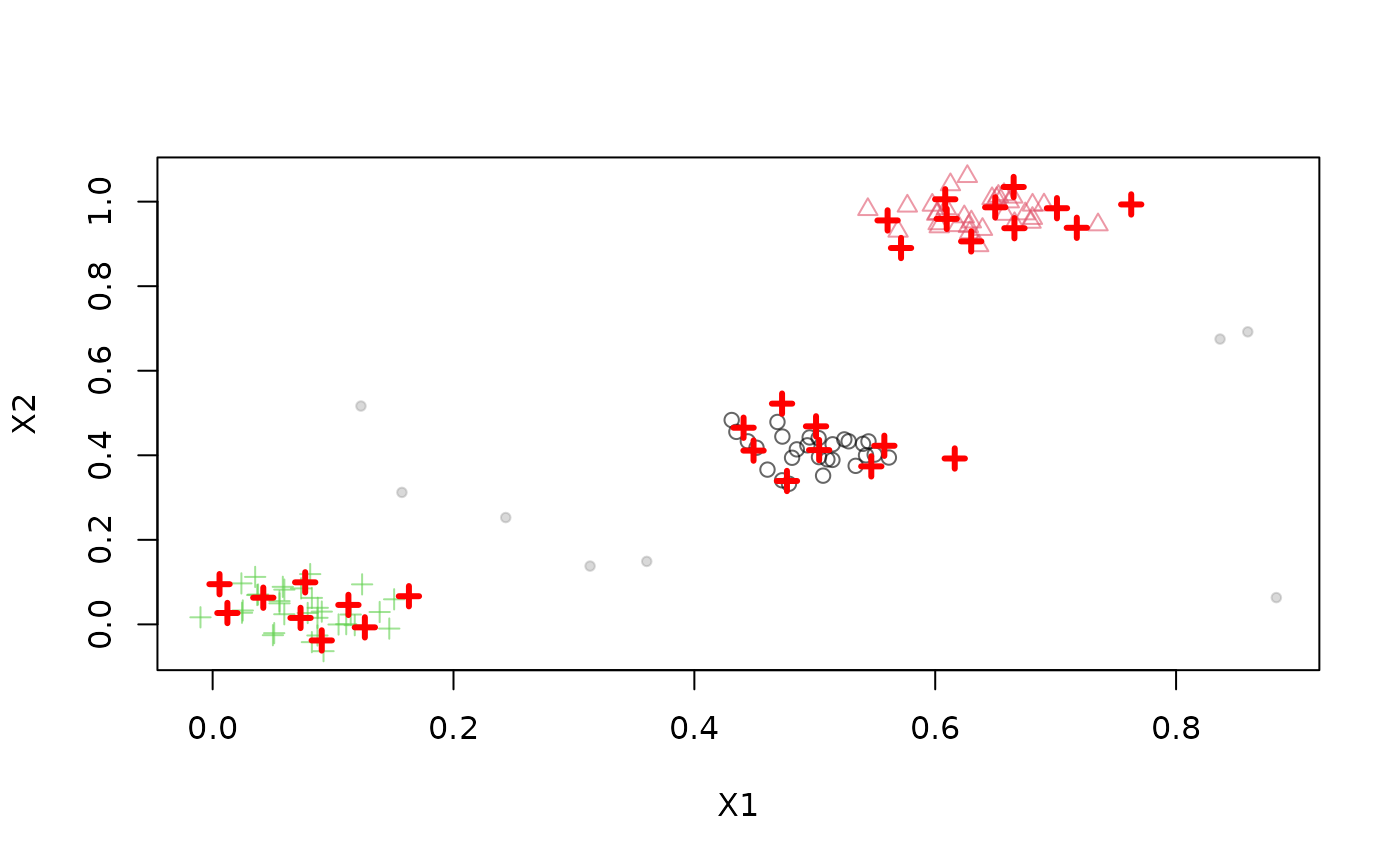
resp <- GET(paste0("http://localhost:", port, "/get_centers"))
d <- content(resp, show_col_types = FALSE)
head(d)
#> # A tibble: 6 × 2
#> X1 X2
#> <dbl> <dbl>
#> 1 0.504 0.412
#> 2 0.126 -0.00704
#> 3 0.701 0.984
#> 4 0.610 0.959
#> 5 0.718 0.938
#> 6 0.0769 0.0995
plot(dsd, n = 100)
points(d, col = "red", pch = 3, lwd = 3)
 # kill the process.
rp1$kill()
#> [1] TRUE
rp1
#> PROCESS 'R', finished.
# Debug the interface (run the service and start a web interface)
if (interactive())
publish_DSC_via_WebService("DSC_DBSTREAM(r = .05)",
port = port, debug = TRUE)
# kill the process.
rp1$kill()
#> [1] TRUE
rp1
#> PROCESS 'R', finished.
# Debug the interface (run the service and start a web interface)
if (interactive())
publish_DSC_via_WebService("DSC_DBSTREAM(r = .05)",
port = port, debug = TRUE)