
Combines two or more EMMs into a single object.
Arguments
- x
first
EMMobject. Note that this object will be changed by the function ifcopy=FALSE!- ...
further objects of the same class as
xto be combined.- copy
a logical. Copy
xfirst? Otherwise x will be changed!- recursive
a logical. If
recursive=TRUE, the function recursively descends through lists combining all their elements into a vector.
Examples
data("16S")
## create two EMMs for different data
emm1 <- EMM("Kullback", threshold=0.1, data=Mollicutes16S+1)
emm2 <- EMM("Kullback", threshold=0.1, data=Alphaproteobacteria16S+1)
## combine the two EMMs
emm12 <- c(emm1, emm2)
## this is the same as:
## emm12 <- copy(emm1)
## c(emm12, emm2, copy=FALSE)
## recluster states so similar states in the to EMMs will be merged
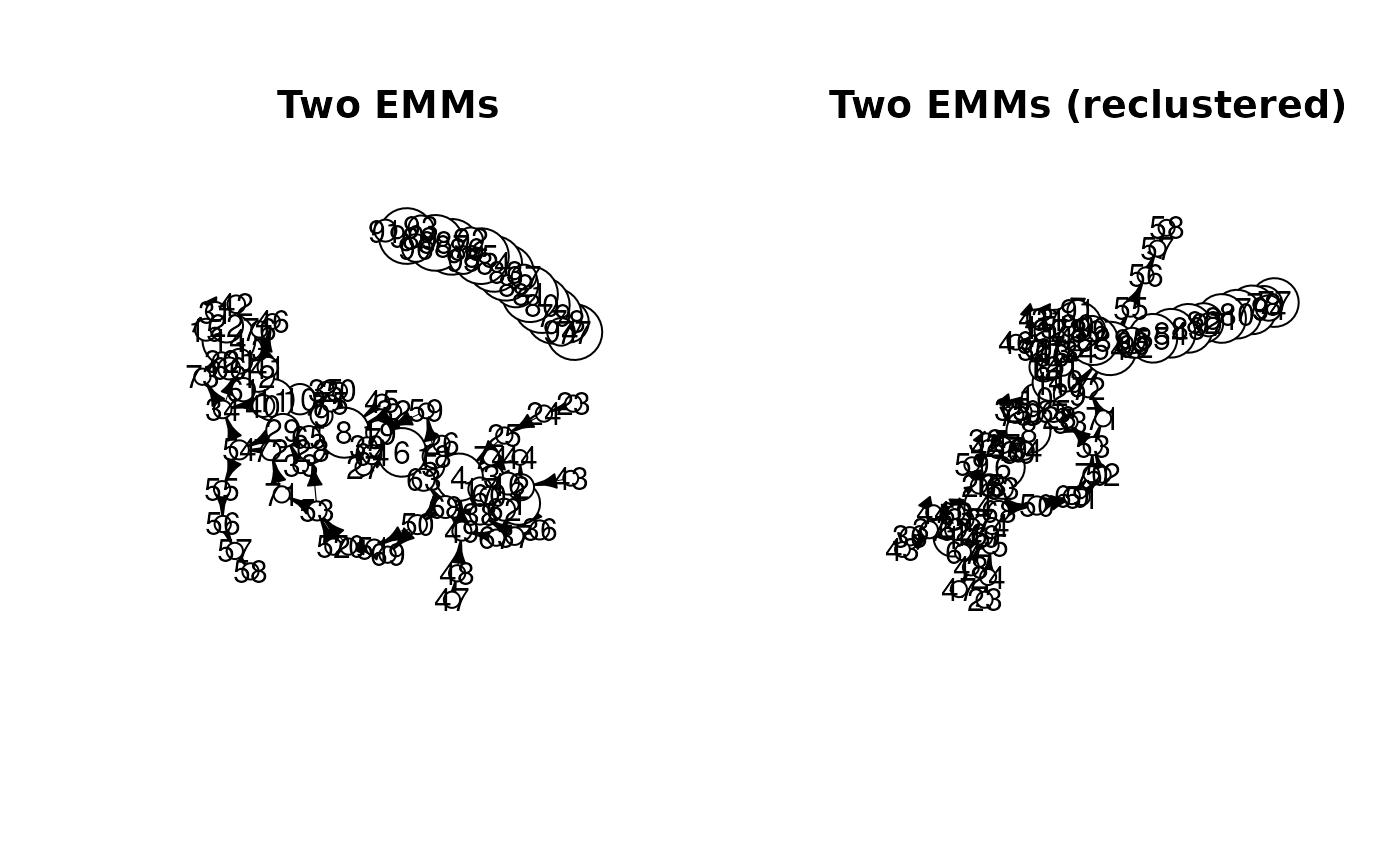
emm12r <- recluster_tNN(emm12)
op <- par(mfrow = c(1, 2), pty = "s")
plot(emm12, main="Two EMMs")
plot(emm12r, main="Two EMMs (reclustered)")
 par(op)