
Add new data to an EMM.
Arguments
- x
an
EMMobject. Note that the function will change the original EMM!- newdata
a vector (one observation), or a matrix or data.frame (each row is an observation)
- ...
further arguments. If
newdatais a matrix or a data.frame thenverbose = TRUEcan be used to monitor the progress of building the model.
Value
A reference to the changed EMM object with the data added.
Note: EMM objects store all variable data in an environment which
enables us to update partial data without copying the whole object. Assignment
will not create a copy! Use the provided method copy().
Details
build() performs clustering and also updates the TRACDS temporal
layer.
NAs are handled in the data by using only the other
dimensions if the data for dissimilarity computation
(see package proxy).
Examples
## load EMMTraffic data
data("EMMTraffic")
EMMTraffic
#> Loc_1 Loc_2 Loc_3 Loc_4 Loc_5 Loc_6 Loc_7
#> 1 20 50 100 30 25 4 10
#> 2 20 80 50 20 10 10 10
#> 3 40 30 75 20 30 20 25
#> 4 15 60 30 30 10 10 15
#> 5 40 15 25 10 35 40 9
#> 6 5 5 40 35 10 5 4
#> 7 0 35 55 2 1 3 5
#> 8 20 60 30 11 20 15 10
#> 9 45 40 15 18 20 20 15
#> 10 15 20 40 40 10 10 14
#> 11 5 45 55 10 10 15 0
#> 12 10 30 10 4 15 15 10
## create EMM
emm <- EMM(measure="eJaccard", threshold=0.2)
## build model using EMMTraffic data (note that the EMM object is
## changed without assignment!)
build(emm, EMMTraffic)
## same as: emm <- build(emm, EMMTraffic)
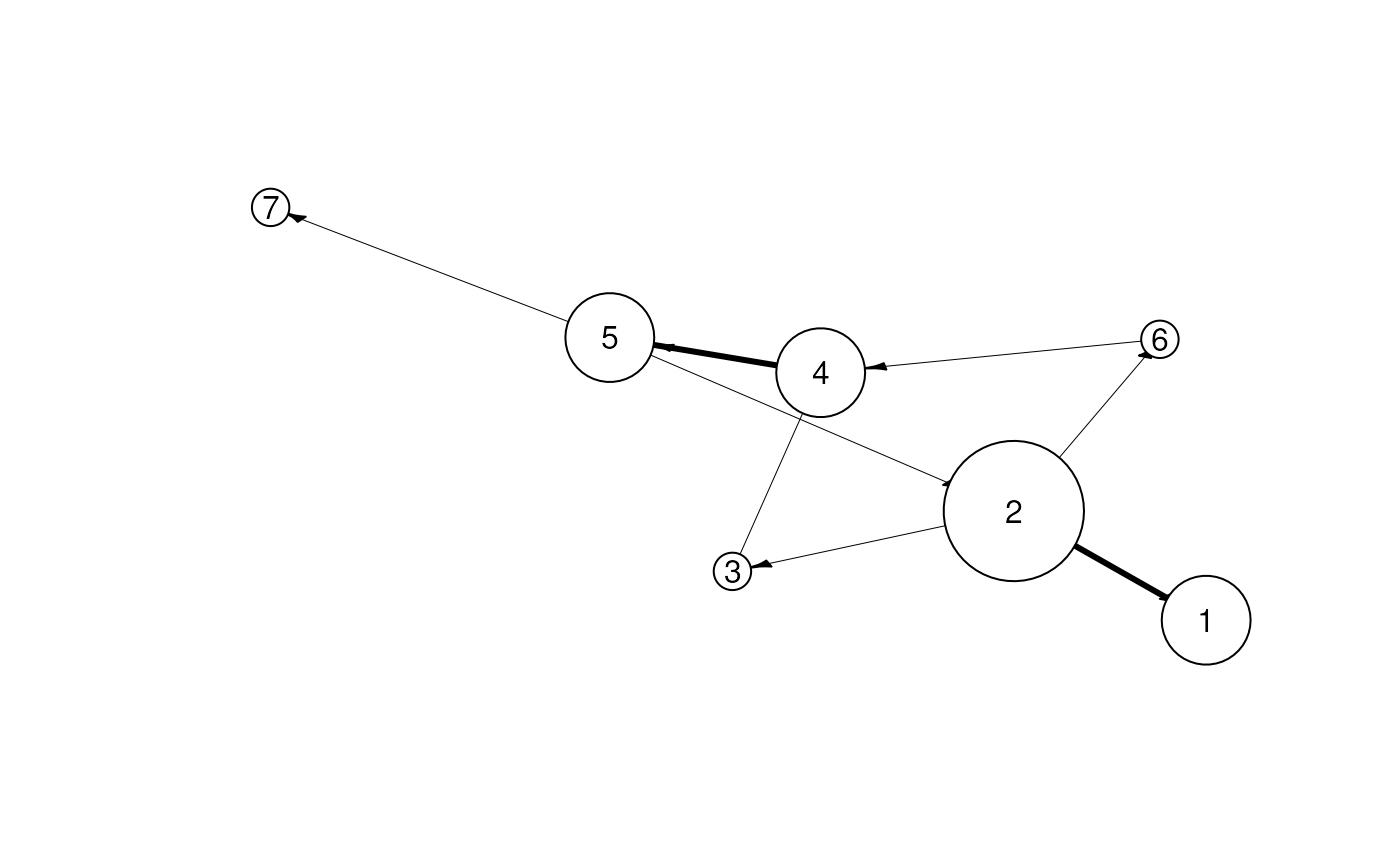
size(emm)
#> [1] 7
plot(emm)
 ## emm2 <- emm does not create a copy (just a reference)
## a "deep" copy is created using copy()
emm2<- copy(emm)
## convert the emm into a graph
as.igraph(emm)
#> IGRAPH 87d2278 DNW- 7 9 --
#> + attr: name (v/c), weight (e/n)
#> + edges from 87d2278 (vertex names):
#> [1] 1->2 2->1 2->3 2->6 3->4 4->5 5->2 5->7 6->4
## emm2 <- emm does not create a copy (just a reference)
## a "deep" copy is created using copy()
emm2<- copy(emm)
## convert the emm into a graph
as.igraph(emm)
#> IGRAPH 87d2278 DNW- 7 9 --
#> + attr: name (v/c), weight (e/n)
#> + edges from 87d2278 (vertex names):
#> [1] 1->2 2->1 2->3 2->6 3->4 4->5 5->2 5->7 6->4