Implements the CluStream algorithm for data streams (Aggarwal et al., 2003).
Arguments
- m
Maximum number of micro-clusters.
- horizon
Time window used by CluStream.
- t
Maximum boundary factor used to decide whether a new point belongs to a micro-cluster. The boundary is
ttimes the root mean square deviation from the micro-cluster center.- k
Number of macro-clusters produced by weighted k-means.
Value
An object of class DSC_CluStream (subclass of
stream::DSC_Micro, DSC_MOA and stream::DSC).
Details
This is an interface to the MOA implementation of CluStream.
If k is specified, then CluStream applies a weighted k-means
algorithm for reclustering (see Examples section below).
References
Aggarwal CC, Han J, Wang J, Yu PS (2003). "A Framework for Clustering Evolving Data Streams." In "Proceedings of the International Conference on Very Large Data Bases (VLDB '03)," pp. 81-92.
Bifet A, Holmes G, Pfahringer B, Kranen P, Kremer H, Jansen T, Seidl T (2010). MOA: Massive Online Analysis, a Framework for Stream Classification and Clustering. In Journal of Machine Learning Research (JMLR).
See also
Other DSC_MOA:
DSC_BICO_MOA(),
DSC_ClusTree(),
DSC_DStream_MOA(),
DSC_DenStream(),
DSC_MCOD(),
DSC_MOA(),
DSC_StreamKM()
Examples
# data with 3 clusters and 5% noise
set.seed(1000)
stream <- DSD_Gaussians(k = 3, d = 2, noise = .05)

# cluster with CluStream
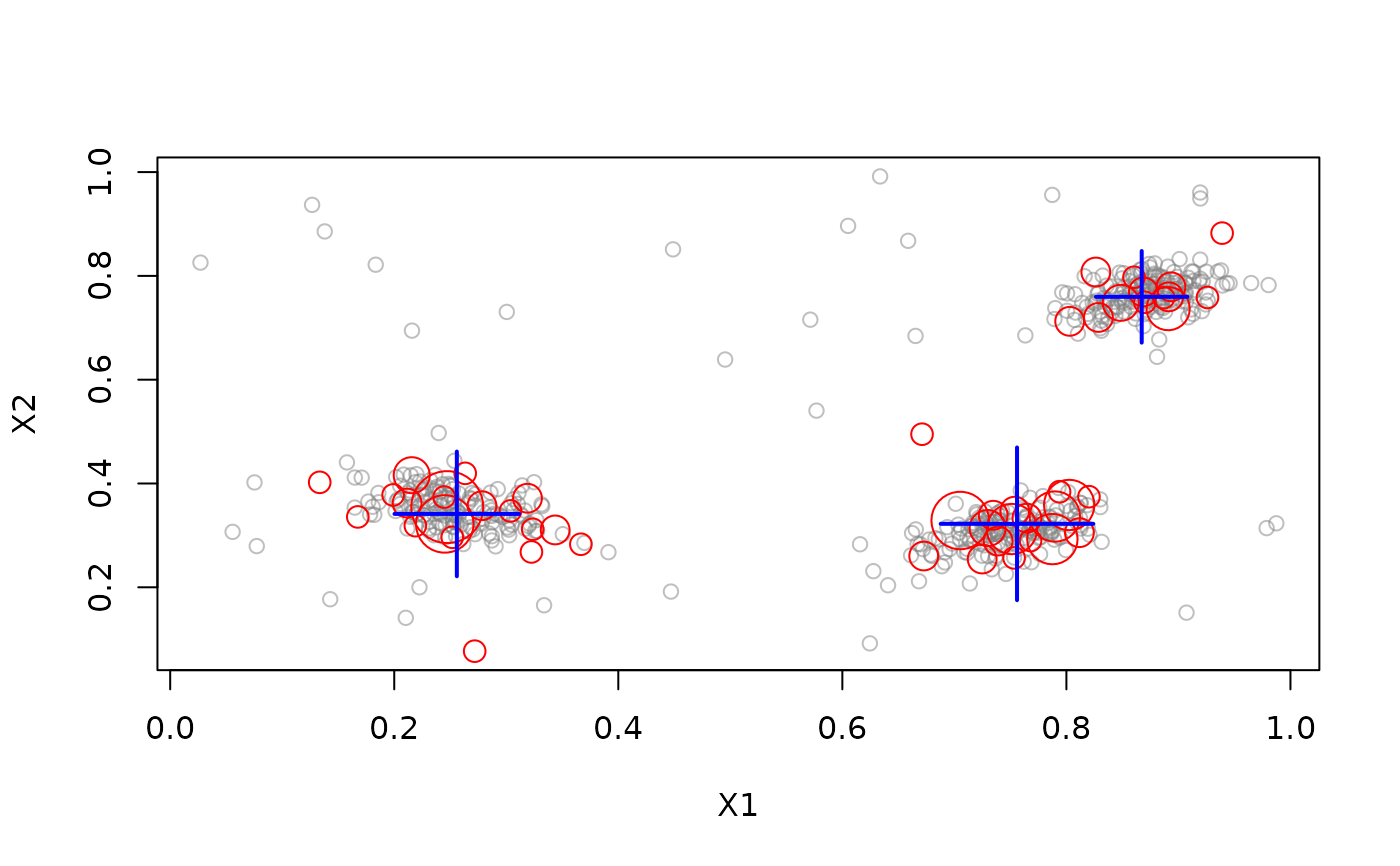
clustream <- DSC_CluStream(m = 50, horizon = 100, k = 3)
update(clustream, stream, 500)
clustream
#> CluStream
#> Class: moa/clusterers/clustream/WithKmeans, DSC_MOA, DSC_Micro, DSC
#> Number of micro-clusters: 50
#> Number of macro-clusters: 3

plot(clustream, stream, type = "both")