Macro Clusterer. Implements the DBSCAN algorithm for reclustering micro-clusterings.
Arguments
- formula
NULLto use all features in the stream or a model formula of the form~ X1 + X2to specify the features used for clustering. Only.,+and-are currently supported in the formula.- eps
radius of the eps-neighborhood.
- MinPts
minimum number of points required in the eps-neighborhood.
- weighted
logical indicating if a weighted version of DBSCAN should be used.
- description
optional character string to describe the clustering method.
Details
DBSCAN is a weighted extended version of the implementation in fpc where each micro-cluster center is considered a pseudo-point. For the MinPts comparison, the sum of the micro-cluster weights is used instead of the number of micro-clusters.
DBSCAN first finds core points based on the number of other points in its eps-neighborhood. Then core points are joined into clusters using reachability (overlapping eps-neighborhoods).
update() and recluster() invisibly return the assignment of the data points to clusters.
Note that this clustering cannot be updated iteratively and every time it is used for (re)clustering, the old clustering is deleted.
References
Martin Ester, Hans-Peter Kriegel, Joerg Sander, Xiaowei Xu (1996). A density-based algorithm for discovering clusters in large spatial databases with noise. In Evangelos Simoudis, Jiawei Han, Usama M. Fayyad. Proceedings of the Second International Conference on Knowledge Discovery and Data Mining (KDD-96). AAAI Press. pp. 226-231.
See also
Other DSC_Macro:
DSC_EA(),
DSC_Hierarchical(),
DSC_Kmeans(),
DSC_Macro(),
DSC_Reachability(),
DSC_SlidingWindow()
Examples
# 3 clusters with 5% noise
stream <- DSD_Gaussians(k = 3, d = 2, noise = 0.05)

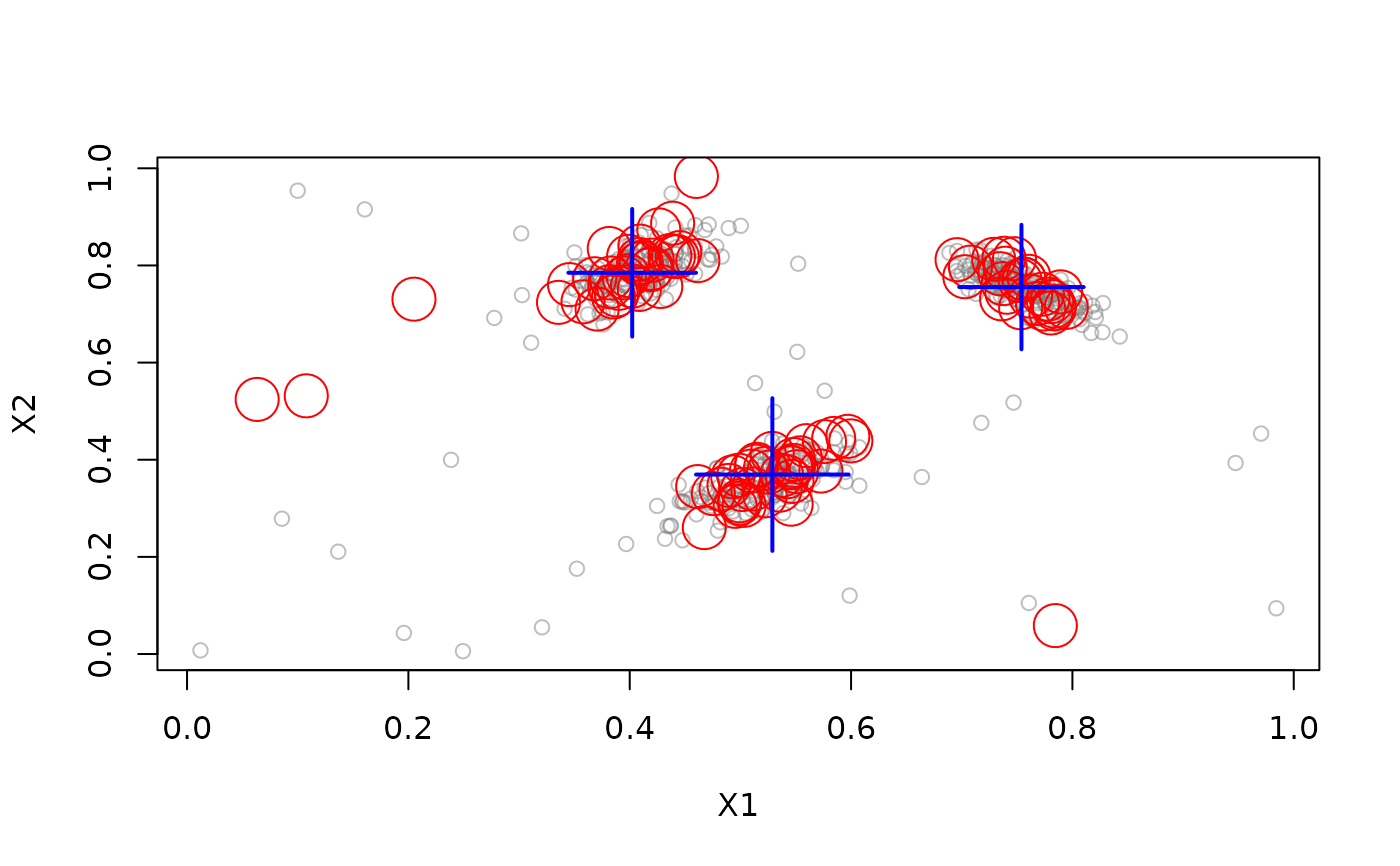
# Use a moving window for "micro-clusters and recluster with DBSCAN (macro-clusters)
cl <- DSC_TwoStage(
  micro = DSC_Window(horizon = 100),
  macro = DSC_DBSCAN(eps = .05)
)

update(cl, stream, 500)
cl
#> Sliding window + DBSCAN (weighted)
#> Class: DSC_TwoStage, DSC_Macro, DSC
#> Number of micro-clusters: 100
#> Number of macro-clusters: 3

plot(cl, stream)