
Class "binaryRatingMatrix": A Binary Rating Matrix
Source:R/AllClasses.R
binaryRatingMatrix-class.RdA matrix for binary rating data. A value of 1 indicates a positive rating; 0 indicates no rating or a negative rating. This coding is common for market-basket data, where products are either bought or not.
See also
itemMatrix in arules,
getList.
Other rating data:
dissimilarity,
ratingMatrix-class,
realRatingMatrix-class
Objects from the Class
Objects can be created by calls of the form new("binaryRatingMatrix", data = im), where im is an itemMatrix as defined in package
arules, by coercion from a matrix (all non-zero values will be a 1),
or by using binarize for
an object of class "realRatingMatrix".
Extends
Class "ratingMatrix", directly.
Methods
- coerce
signature(from = "matrix", to = "binaryRatingMatrix"): The matrix needs to be a logical matrix, or a 0-1 matrix (0 means FALSE and 1 means TRUE). NAs are interpreted as FALSE.- coerce
signature(from = "itemMatrix", to = "binaryRatingMatrix")- coerce
signature(from = "data.frame", to = "binaryRatingMatrix")- coerce
signature(from = "binaryRatingMatrix", to = "matrix")- coerce
signature(from = "binaryRatingMatrix", to = "dgTMatrix")- coerce
signature(from = "binaryRatingMatrix", to = "ngCMatrix")- coerce
signature(from = "binaryRatingMatrix", to = "dgCMatrix")- coerce
signature(from = "binaryRatingMatrix", to = "itemMatrix")- coerce
signature(from = "binaryRatingMatrix", to = "list")
% \item{dissimilarity}{\code{signature(x = "binaryRatingMatrix")}}
% \item{LIST}{\code{signature(from = "binaryRatingMatrix")}: ... }
Examples
## create a 0-1 matrix
m <- matrix(sample(c(0,1), 50, replace=TRUE), nrow=5, ncol=10,
dimnames=list(users=paste("u", 1:5, sep=''),
items=paste("i", 1:10, sep='')))
m
#> items
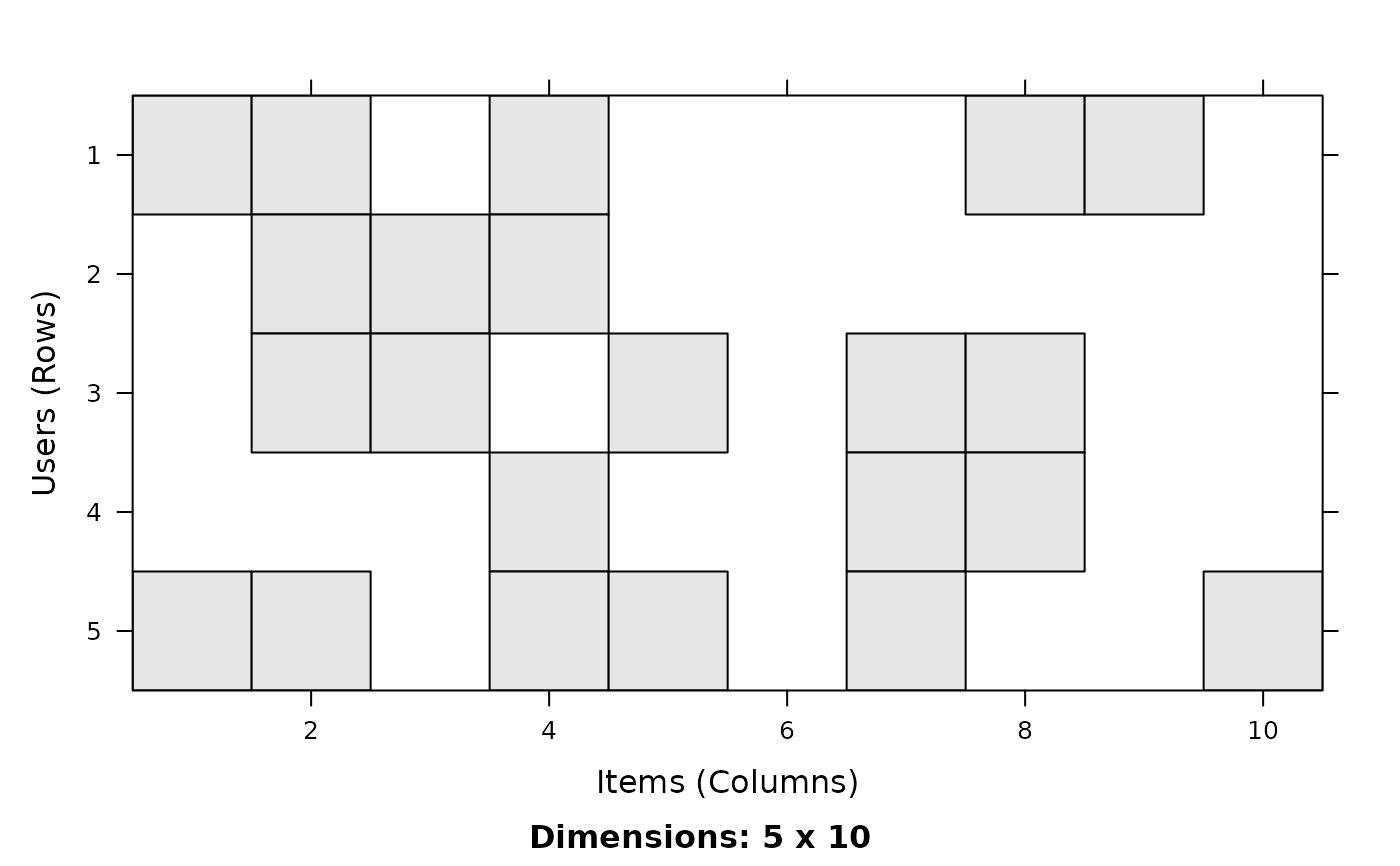
#> users i1 i2 i3 i4 i5 i6 i7 i8 i9 i10
#> u1 1 1 0 1 0 0 0 1 1 0
#> u2 0 1 1 1 0 0 0 0 0 0
#> u3 0 1 1 0 1 0 1 1 0 0
#> u4 0 0 0 1 0 0 1 1 0 0
#> u5 1 1 0 1 1 0 1 0 0 1
## coerce it into a binaryRatingMatrix
b <- as(m, "binaryRatingMatrix")
b
#> 5 x 10 rating matrix of class ‘binaryRatingMatrix’ with 22 ratings.
## coerce it back to see if it worked
as(b, "matrix")
#> i1 i2 i3 i4 i5 i6 i7 i8 i9 i10
#> u1 TRUE TRUE FALSE TRUE FALSE FALSE FALSE TRUE TRUE FALSE
#> u2 FALSE TRUE TRUE TRUE FALSE FALSE FALSE FALSE FALSE FALSE
#> u3 FALSE TRUE TRUE FALSE TRUE FALSE TRUE TRUE FALSE FALSE
#> u4 FALSE FALSE FALSE TRUE FALSE FALSE TRUE TRUE FALSE FALSE
#> u5 TRUE TRUE FALSE TRUE TRUE FALSE TRUE FALSE FALSE TRUE
## use some methods defined in ratingMatrix
dim(b)
#> [1] 5 10
dimnames(b)
#> [[1]]
#> [1] "u1" "u2" "u3" "u4" "u5"
#>
#> [[2]]
#> [1] "i1" "i2" "i3" "i4" "i5" "i6" "i7" "i8" "i9" "i10"
#>
## counts
rowCounts(b) ## number of ratings per user
#> u1 u2 u3 u4 u5
#> 5 3 5 3 6
colCounts(b) ## number of ratings per item
#> i1 i2 i3 i4 i5 i6 i7 i8 i9 i10
#> 2 4 2 4 2 0 3 3 1 1
## plot
image(b)
 ## sample and subset
sample(b,2)
#> 2 x 10 rating matrix of class ‘binaryRatingMatrix’ with 10 ratings.
b[1:2,1:5]
#> 2 x 5 rating matrix of class ‘binaryRatingMatrix’ with 6 ratings.
## coercion
as(b, "list")
#> $u1
#> [1] "i1" "i2" "i4" "i8" "i9"
#>
#> $u2
#> [1] "i2" "i3" "i4"
#>
#> $u3
#> [1] "i2" "i3" "i5" "i7" "i8"
#>
#> $u4
#> [1] "i4" "i7" "i8"
#>
#> $u5
#> [1] "i1" "i2" "i4" "i5" "i7" "i10"
#>
head(as(b, "data.frame"))
#> user item rating
#> 1 u1 i1 1
#> 3 u1 i2 1
#> 9 u1 i4 1
#> 18 u1 i8 1
#> 21 u1 i9 1
#> 4 u2 i2 1
head(getData.frame(b, ratings=FALSE))
#> user item
#> 1 u1 i1
#> 3 u1 i2
#> 9 u1 i4
#> 18 u1 i8
#> 21 u1 i9
#> 4 u2 i2
## creation from user/item tuples
df <- data.frame(user=c(1,1,2,2,2,3), items=c(1,4,1,2,3,5))
df
#> user items
#> 1 1 1
#> 2 1 4
#> 3 2 1
#> 4 2 2
#> 5 2 3
#> 6 3 5
b2 <- as(df, "binaryRatingMatrix")
b2
#> 3 x 5 rating matrix of class ‘binaryRatingMatrix’ with 6 ratings.
as(b2, "matrix")
#> 1 2 3 4 5
#> 1 TRUE FALSE FALSE TRUE FALSE
#> 2 TRUE TRUE TRUE FALSE FALSE
#> 3 FALSE FALSE FALSE FALSE TRUE
## sample and subset
sample(b,2)
#> 2 x 10 rating matrix of class ‘binaryRatingMatrix’ with 10 ratings.
b[1:2,1:5]
#> 2 x 5 rating matrix of class ‘binaryRatingMatrix’ with 6 ratings.
## coercion
as(b, "list")
#> $u1
#> [1] "i1" "i2" "i4" "i8" "i9"
#>
#> $u2
#> [1] "i2" "i3" "i4"
#>
#> $u3
#> [1] "i2" "i3" "i5" "i7" "i8"
#>
#> $u4
#> [1] "i4" "i7" "i8"
#>
#> $u5
#> [1] "i1" "i2" "i4" "i5" "i7" "i10"
#>
head(as(b, "data.frame"))
#> user item rating
#> 1 u1 i1 1
#> 3 u1 i2 1
#> 9 u1 i4 1
#> 18 u1 i8 1
#> 21 u1 i9 1
#> 4 u2 i2 1
head(getData.frame(b, ratings=FALSE))
#> user item
#> 1 u1 i1
#> 3 u1 i2
#> 9 u1 i4
#> 18 u1 i8
#> 21 u1 i9
#> 4 u2 i2
## creation from user/item tuples
df <- data.frame(user=c(1,1,2,2,2,3), items=c(1,4,1,2,3,5))
df
#> user items
#> 1 1 1
#> 2 1 4
#> 3 2 1
#> 4 2 2
#> 5 2 3
#> 6 3 5
b2 <- as(df, "binaryRatingMatrix")
b2
#> 3 x 5 rating matrix of class ‘binaryRatingMatrix’ with 6 ratings.
as(b2, "matrix")
#> 1 2 3 4 5
#> 1 TRUE FALSE FALSE TRUE FALSE
#> 2 TRUE TRUE TRUE FALSE FALSE
#> 3 FALSE FALSE FALSE FALSE TRUE